Panginoon, Ibigay Mo sa Amin ang Bundok na Ito
Ikawalong Tomo · Cyril at Anna Brooks
Ang Misyonerong Nag-anyaya kay Itay
Lingfield · Victoria · Maynila · San Juan · Baguio
Ken at Mary Lou Engle · Isang Kasaysayan ng Pamilya Engle
Mga Nilalaman
Ikawalong Tomo · 1898–1986
- Dad at Mom Brooks4
- Ang Kaniyang Buhay5
- Ang Buhay ni Cyril Brooks sa Maikling Salita6
- Ang Misyonerong Nag-anyaya kay Itay7
- Isang Binata sa Moody8
- Parang Sariling Anak9
- Limandaang Dolyar sa Almusal10
- Mga Batang Brigade at ang Baguio11
- Mom at Dad12
- Grace Abounding, Grace Triumphant13
- Mag-ugat Pababa14
- Ang mga Engle sa Grace Triumphant15
- Ang Brigade sa San Juan16
- Ang Paanyaya17
- Si Evelyn at ang Asembleya sa Baguio18
- Mga Biblia para sa mga Kadete20
- Ken Engle sa Bible School of the Air21
- Limandaang Dolyar22
- Dalawang Taon sa Baguio23
- Rudy at ang Brigade24
- Sa Sarili Niyang mga Salita25
- His Word Runs Swiftly26
- Early Days of Gospel Broadcasting33
- Progress of Missions in the Philippines39
- Call to Missions49
- Daily Church Growth53
- Bible School of the Air News, May 196756
- Mga Larawan at Papeles58
- Basahin Pa69
- Mga Pinagkunan70
- Mga Kasamang Aklat71
Cyril at Anna Brooks
Ang Misyonerong Nag-anyaya kay Itay · 1898–1986
Idinagdag noong Oktubre 13, 2026
Ikawalong Tomo
Dad at Mom Brooks
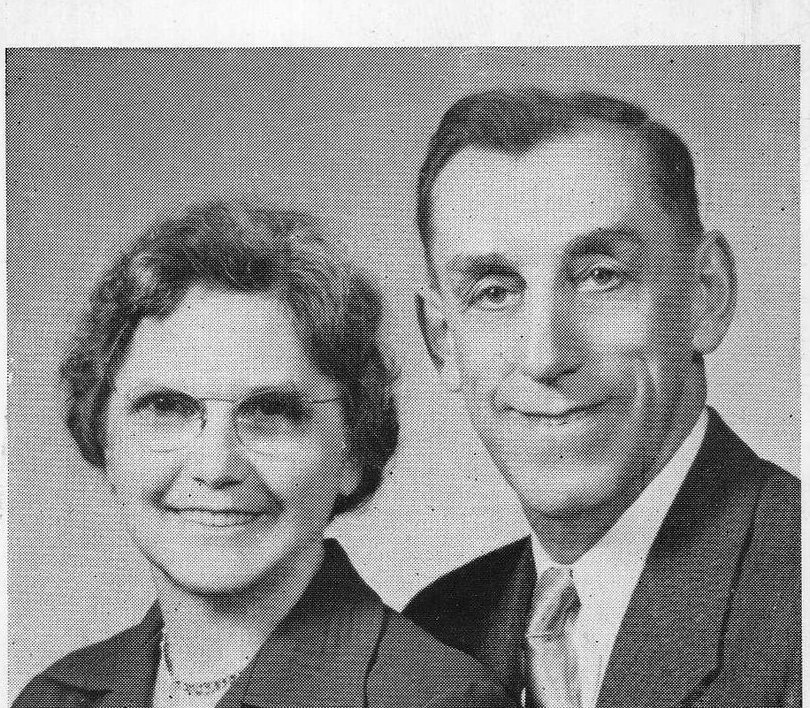
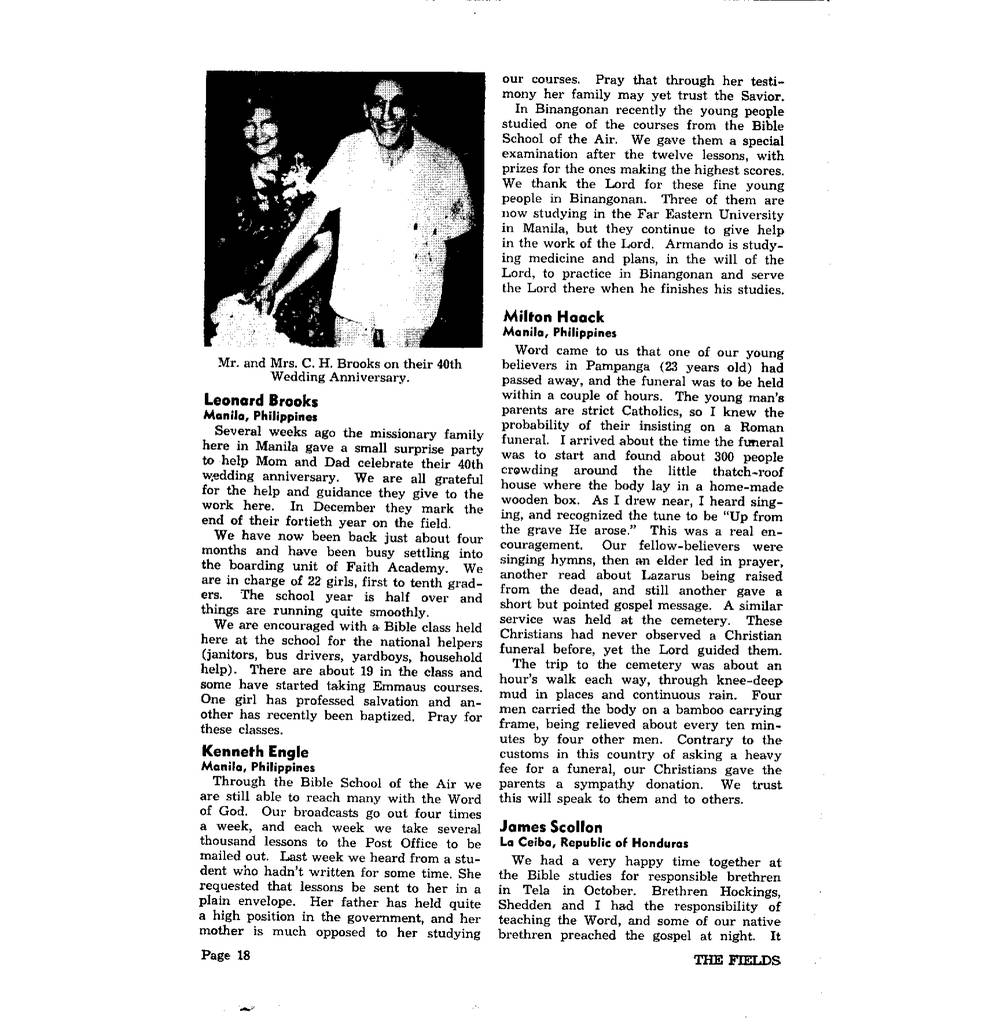
Si Cyril H. Brooks ang misyonerong nag-anyaya kay Ken Engle na pumunta sa Pilipinas. Sila ng kaniyang asawang si Anna ang sumalubong kay Ken sa Look ng Maynila noong Marso 1951, tumanggap sa kaniya sa kanilang tahanan sa San Juan, at nagbigay sa nobya nang ikasal siya kay Mary Lou. Habang sila ay nabubuhay, “Dad at Mom Brooks” ang tawag sa kanila nina Ken at Mary Lou.
Isinasalaysay ng tomong ito ang kanilang kuwento: ang buhay ni Dad Brooks sa maikling salita; sina Cyril at Anna Brooks at ang mga Engle; ang walong bahagi ng kaniyang aklat na tungkol sa mga Engle, sa Tagalog; limang artikulo niya, sa orihinal na Ingles; at mga larawan at papeles mula sa talaksan nina Ken at Mary Lou. Ang buo niyang aklat, Grace Triumphant, ay nasa serye sa Ingles.
Huwag ninyong agawan ang Diyos ng anumang kaluwalhatian sa pagbibigay ng anumang papuri sa amin.
Cyril H. Brooks, Panimula sa Grace Triumphant
Mula sa Grace Triumphant (© 1985 Walterick Publishers).
Ang Kaniyang Buhay
Lingfield · Victoria · Vimy Ridge · Maynila · Los Baños · 1898–1950
Idinagdag noong Oktubre 13, 2026
1898–1950
Ang Buhay ni Cyril Brooks sa Maikling Salita
1898. Isinilang noong Disyembre 11 malapit sa Lingfield, Surrey, England. Ipinangalan siya kay Cyril Bird, isang misyonerong namatay sa Angola, at bago pa siya isilang ay inihandog na siya ng kaniyang mga magulang sa Panginoon para sa gawaing misyonero.
1912. Nabautismuhan sa Lingfield; naglayag kasama ang kaniyang ina patungong Canada at nanirahan sa Victoria, British Columbia.
1915–1919. Naging sundalo sa edad na labing-anim. Signaler siya sa Pransiya at Belgium, sa Vimy Ridge at Passchendaele. “Sa loob ng dalawang taon ng labanan, hindi ako kailanman nagpaputok ng anumang baril.”
1919–1920. Narinig niya ang tinig ng Panginoon: “Iniligtas kita upang pumunta sa larangan ng misyon!” Muntik siyang mamatay sa pulmonya, ngunit nabuhay.
1922. Ikinasal kay Anna Carson ng Buffalo noong Setyembre 20. Dumating sila sa Maynila noong Disyembre 20.
1929–1941. Sinimulan ang gawain sa San Juan, Rizal, at ang programang pang-radyo na The Gospel Messengers.
1942–1945. Mga bilanggo sa sariling bahay, at pagkatapos ay sa kampo ng Los Baños. Iniligtas noong Pebrero 23, 1945.
1950. Noong Abril 17 nagsimula ang Bible School of the Air sa Far East Broadcasting Company.
Mula sa Grace Triumphant (© 1985 Walterick Publishers). Ang buong kuwento sa Ingles ay nasa Grace Triumphant at sa Ikawalong Tomo ng edisyong Ingles.
Ang Misyonerong Nag-anyaya kay Itay
Sina Cyril at Anna Brooks at ang mga Engle · 1949–1986
Idinagdag noong Oktubre 13, 2026
1949–1951
Isang Binata sa Moody
Ganito ito isinalaysay ni Dad Brooks sa sarili niyang aklat.
Bago kami bumalik sa Pilipinas noong 1949, nabalitaan namin ang isang binatang nag-aaral sa Moody Bible Institute na interesado sa gawain sa Pilipinas. Noong Ikalawang Digmaang Pandaigdig ay lumipad siya sa ibabaw ng Pilipinas sakay ng B-24 “Liberator,” at nais niyang bumalik dito sa isang mas mapayapang misyon. Matapos kaming magsulatan, sumama sa amin si Kenneth Engle sa Maynila noong 1951.
Cyril H. Brooks, Grace Triumphant, kabanata 22
Ang panig ni Ken ay nasa Ikalawang Tomo: “Ang Pulong-Panalangin sa Moody”. Noong Mayo 1950 ay sumulat si Brooks: “Tiyak na may lugar para sa iyo upang tumulong sa San Juan kung tatawagin ka ng Panginoon na makasama namin sa gawain.”
Makalipas ang tatlumpu’t limang taon ay naaalala pa ni Ken ang mga unang aralin. “Naaalala ba ninyo ang mga babasahing ibinigay ninyo sa akin noong 1950?” sulat niya kina Dad at Mom Brooks noong 1985.
Mula sa Grace Triumphant (© 1985 Walterick Publishers), kabanata 22; liham ni Ken Engle sa mga Brooks, Setyembre 16, 1985.
1951–1953
Parang Sariling Anak
Maaga noong Sabado, Marso 17, 1951, naghihintay na sina Cyril at Anna Brooks sa Look ng Maynila upang sunduin si Ken. Nang Lunes na iyon ay nagbukas si Ken ng mga liham para sa Bible School of the Air, at nang gabing iyon ay kinapanayam siya ni Cyril sa DZAS. Tumira siya sa tahanan ng mga Brooks sa San Juan hanggang sa siya’y ikasal.
Tumira siya sa amin hanggang sa ikasal siya at para na rin namin siyang anak. Kakatwa, inakala ng maraming tao na manugang namin siya!
Cyril H. Brooks, Grace Triumphant, kabanata 23
Noong Abril 26, 1953, sa San Juan Gospel Hall, si Cyril Brooks ang nagbigay sa nobya nang ikasal si Ken kay Mary Lou Leonard. Si Ken Brooks ang best man, at ang batang si Dale Brooks ang nagdala ng mga singsing. Sa tahanan ng mga Brooks ginanap ang salu-salo.
Tinanggap nila ako sa kanilang tahanan nang dumating ako sa larangan noong 1951 at itinuring akong parang sarili nilang anak.
Ken Engle, Marso 28, 1980
Mula sa Grace Triumphant (© 1985 Walterick Publishers), kabanata 23; mga liham ni Ken Engle, Mayo 20, 1953 at Marso 28, 1980.
Ang Bible School of the Air
Limandaang Dolyar sa Almusal
Sa pananampalataya nabuhay ang Bible School of the Air. Isang umaga ay kinuwenta ni Dad Brooks na mga limandaang dolyar ang kailangan para sa paglilimbag at selyo, at idinulog niya ito sa Panginoon.
Nang umupo kami para mag-almusal pagkatapos ng aking debosyon, dumaan si Ken Engle. Sa kung anong dahilan ay kinailangan niyang lumabas nang maaga noong umagang iyon at dumaan siya sa post office upang kunin ang aming sulat. Sa aming tuwa (at pagkamangha, aaminin ko) may isang liham na may lamang tseke na $500.
Cyril H. Brooks, Grace Triumphant, kabanata 23
Muli niyang ikinuwento ito noong 1981, sa “His Word Runs Swiftly”: “Hindi nabigo ang Diyos—hindi Siya maaaring mabigo.”
Ganito rin ang paraan ng pamumuhay na natutuhan nina Ken at Mary Lou: sa Diyos lamang nila sinasabi ang kanilang mga pangangailangan.
Mula sa Grace Triumphant (© 1985 Walterick Publishers), kabanata 23; “His Word Runs Swiftly,” Missions, Nobyembre 1981.
1951–1979
Mga Batang Brigade at ang Baguio
Noong unang bahagi ng dekada 1950, sinimulan nina Ken Engle at Ken Brooks, sa tulong ng mga sundalong Amerikano, ang Christian Service Brigade sa San Juan. Isa sa mga unang batang lalaki si Rudy Ponce de Leon, ang unang Herald of Christ sa labas ng Estados Unidos.
Noong 1967 ay lumipat ang mga Engle sa Baguio. Isinulat ni Dad Brooks ang tungkol kay Mary Lou at kay Evelyn Balanag, at sa apat na binautismuhan ni Ken noong unang bahagi ng 1970: “iyon ang pasimula ng asembleya roon.” Nang umuwi ang mga Engle sa Amerika noong taon ding iyon, umakyat sa bundok sina Cyril at Anna, kapwa lampas na sa pitumpung taong gulang, at doon tumira nang dalawang taon.
May mga batang Kristiyano na kailangang alagaan.
Grace Triumphant, kabanata 25
Nang umalis ang mga Engle sa larangan, ipinagpatuloy ni Dad Brooks ang pagbibigay ng Biblia sa mga kadeteng nagtatapos sa Philippine Military Academy. Noong 1978 ay nagbigay siya ng Biblia sa 139 na nagtapos.
Mula sa Grace Triumphant (© 1985 Walterick Publishers), mga kabanata 20, 22 at 25.
Ang mga liham, 1972–1985
Mom at Dad
Patuloy ang mga liham nang umuwi ang mga Engle sa Kansas noong 1975. Inilista ni Ken ang bawat liham, pakete at larawang ipinadala niya. Sumasagot si Dad Brooks sa manipis na papel ng airmail mula sa P.O. Box 652, Greenhills, may balita tungkol sa San Juan, sa Bible School of the Air, sa Camp, at sa iglesya sa Baguio.
Pinagpala kami na makapunta sa ibang bansa at magkaroon ng mga ampong magulang na tulad ninyo.
Ken Engle kina Dad at Mom Brooks, Oktubre 12, 1982
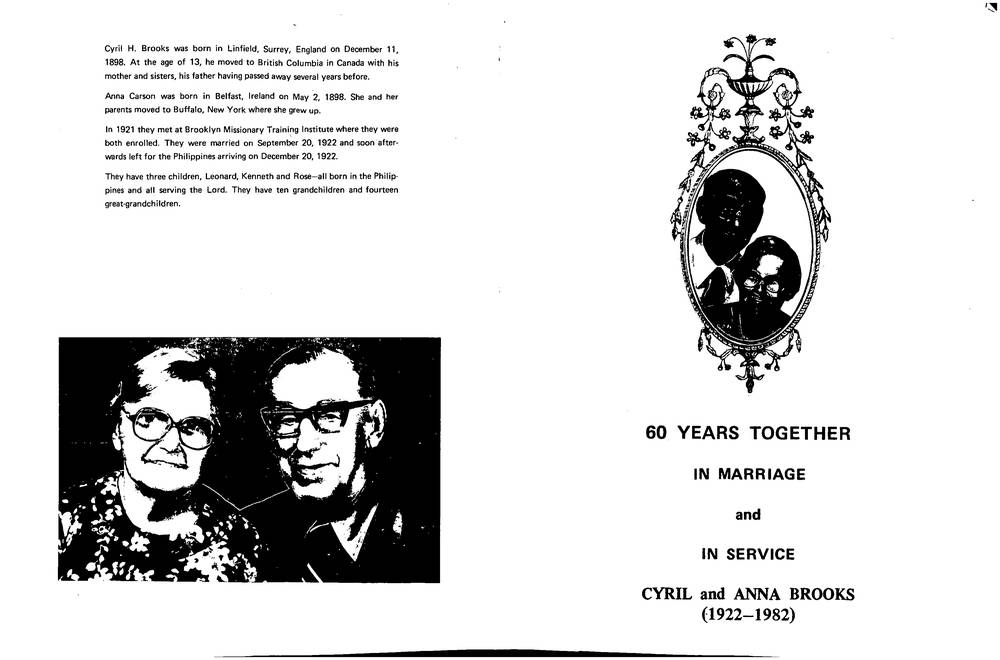
Sa kanilang ikaanimnapung anibersaryo noong Setyembre 1982, mahigit dalawandaang kaibigan ang nagtipon sa Maynila. Sumulat si Dad Brooks: “Isa itong tala ng kahanga-hangang biyaya ng Diyos sa buong daan.”
Alam naming marami ang tumatawag sa inyo ng “Mom at Dad,” ngunit sa tingin namin, bukod sa sarili ninyong mga anak, kami marahil ang pinakanakinabang sa inyo. SALAMAT.
Ken Engle kina Dad at Mom Brooks, Setyembre 16, 1985
Mula sa mga liham ng mga Brooks sa talaksan nina Ken at Mary Lou Engle, 1972–1986.
1984–1985
Grace Abounding, Grace Triumphant
Noong 1984 ay inalok ni John D. Williams ng Walterick Publishers sa Kansas City na ilathala ang kuwento ng buhay ni Dad Brooks. Pumayag siya, ngunit ayaw niyang tumanggap ng royalty: “Ayokong kumita rito.” Hiniling niyang pasalamatan sina Ken at Mary Lou sa kanilang tulong. Grace Abounding ang unang pamagat; naging Grace Triumphant ito.
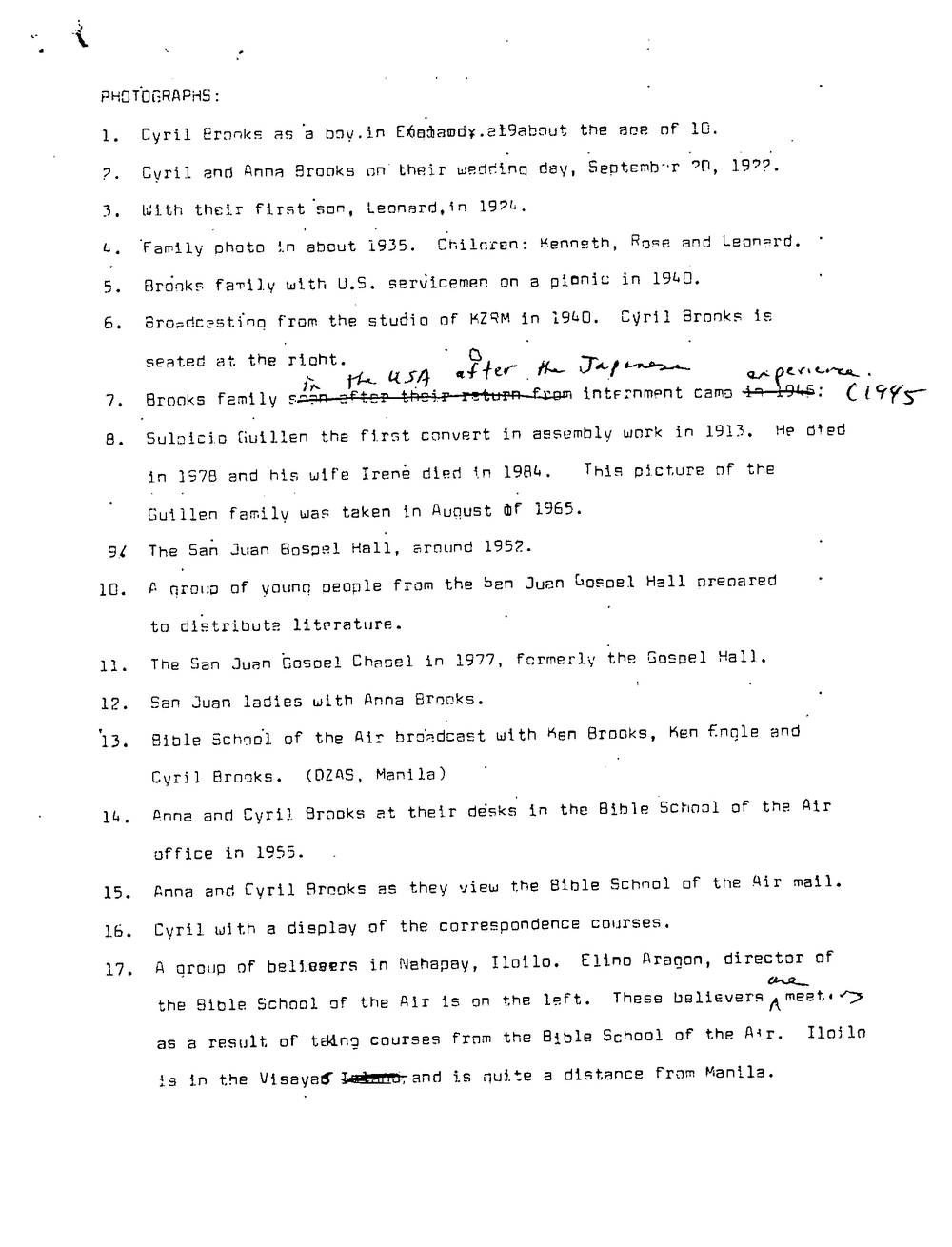
Pumili si Ken ng dalawampu’t anim na larawan, mula kay Cyril bilang batang sampung taong gulang sa England hanggang kina Cyril at Anna sa Baguio, at siya ang nag-type ng mga caption. Ipinadala niya ang mga ito sa Walterick noong Marso 27, 1985.
Sampung kopya ang dumating sa Abilene noong Oktubre 24, 1985. Nasa seryeng ito ang buong aklat, sa Ingles: Grace Triumphant.
Mula sa mga liham sa talaksan nina Ken at Mary Lou Engle, 1984–1985.
1985–1986
Mag-ugat Pababa
Noong Agosto 28, 1985, ginawaran si Dad Brooks ng International Baptist Theological College ng honorary Doctor of Divinity “bilang pagkilala sa aming maraming taon ng paglilingkod dito.” Sa huling bahagi ng taong iyon ay natapos niyang isulat ang mga iskrip sa radyo para sa lahat ng kursong Emmaus.
Apat na araw bago siya naospital noong unang bahagi ng 1986, ibinigay niya ang kaniyang huling mensahe sa mga kababaihan ng asembleya sa San Juan.
Hinamon niya kaming “mag-ugat pababa at mamunga paitaas.”
Rose Brooks, Marso 12, 1986 (Isaias 37:31)
Umuwi siya sa Panginoon nang 11:45 ng umaga ng Lunes, Marso 3, 1986, kasama si Rose sa tabi ng kaniyang higaan. Ginanap ang libing sa San Juan Gospel Chapel. Sumunod sa kaniya si Mom Brooks noong Miyerkoles, Mayo 21, 1986.
Sana ay nakarating sa inyo ang balita ng pag-uwi ni Dad, sapagkat tunay na parang pamilya kayo ni Dad.
Rose Brooks kina Ken at Mary Lou, Marso 12, 1986
Mula sa mga liham at mga tala ni Ken Engle sa kaniyang talaksan tungkol sa mga Brooks, 1985–1986.
Ang mga Engle sa Grace Triumphant
Ang walong bahagi ng aklat ni Dad Brooks na tungkol kina Ken at Mary Lou, isinalin sa Tagalog
Idinagdag noong Oktubre 13, 2026
Kabanata 20
Ang Brigade sa San Juan
Noong dekada 1950, sinimulan nina Ken Engle at Ken Brooks, sa tulong ng ilang sundalong Amerikano, ang isang Boy’s Brigade. Naging tunay na pagpapala ito sa buhay ng marami habang lumalaki ang mga bata sa espirituwal at pisikal na kapanahunan. Ang ilan sa mga matanda at diyakono ay dating natulungan sa Brigade. Nagpapatuloy pa ang gawaing ito sa pangunguna ng mga binatang Pilipino. Kabilang sa mga unang nagkamit ng gantimpalang “Herald of Christ” sa labas ng Estados Unidos ang dalawang taga-San Juan.
Grace Triumphant, kabanata 20
Sa sarili niyang kopya ay itinama ni Ken Engle ang petsa: “sa unang bahagi ng dekada 1950 (hindi 1959).”
Mula sa Grace Triumphant (© 1985 Walterick Publishers). Isinalin sa Tagalog para sa seryeng ito.
Kabanata 22
Ang Paanyaya
Bago kami bumalik sa Pilipinas noong 1949, nabalitaan namin ang isang binatang nag-aaral sa Moody Bible Institute na interesado sa gawain sa Pilipinas. Noong Ikalawang Digmaang Pandaigdig ay lumipad siya sa ibabaw ng Pilipinas sakay ng B-24 “Liberator,” at nais niyang bumalik dito sa isang mas mapayapang misyon. Matapos kaming magsulatan, sumama sa amin si Kenneth Engle sa Maynila noong 1951. Nagtrabaho siya sa radyo sa WMBI habang nasa Moody, kaya malaki ang naitulong niya nang ipagpatuloy namin noon ang ministeryo sa radyo. Nang maglaon ay sumunod ang kaniyang nobya, si Mary Lou Leonard, at ikinasal sila sa San Juan. Ilang taon silang tumulong sa asembleya sa Binangonan. Pagkatapos, noong 1967, lumipat sila sa Baguio dahil sa kalusugan.
Grace Triumphant, kabanata 22
Mula sa Grace Triumphant (© 1985 Walterick Publishers). Isinalin sa Tagalog para sa seryeng ito.
Kabanata 22
Si Evelyn at ang Asembleya sa Baguio
Sa Baguio ay nagsimula silang makipagkilala sa mga kapitbahay upang magtatag ng gawain doon. Isa sa mga naging kaibigan ni Mary Lou ang isang babaeng taga-Pakistan na asawa ng isang propesor na Pilipino. Naging interesado ang babaeng ito, si Evelyn Balanag, sa kursong “What the Bible Teaches.” Iniuwi niya ang unang dalawang aralin at hindi nagtagal ay bumalik siya para sa iba pa, at bago natapos ang araw ay natapos na niya ang lahat. Kinabukasan ay malubha siyang nagkasakit at isinugod sa ospital. Sa matinding panghihina ay inakala niyang mamamatay na siya. Naisip niya: “Kung namatay ako, sa impiyerno sana ako napunta.” Naalala niya ang kaniyang pinag-aralan sa mga aralin, at tinanggap niya si Cristo bilang kaniyang Tagapagligtas.
Grace Triumphant, kabanata 22
Apat sa mga taong ito ang binautismuhan ni Ken Engle noong unang bahagi ng 1970, at iyon ang pasimula ng asembleya roon. Habang nasa furlough ang mga Engle mula 1970 hanggang 1972, tumira kami sa Baguio at nadama naming ang aming ministeryo ay palakasin ang mga mananampalatayang ito sa kanilang pananampalataya kay Cristo. Bumalik ang mga Engle noong 1973 at nanatili hanggang 1975. Nakabili ang asembleya ng lote at nakapagtayo ng kapilya.
Grace Triumphant, kabanata 22
Ang buong kuwento ay nasa “Mary Lou, Mary Lou”: Ang Kuwento nina Evelyn at Fred Balanag.
Mula sa Grace Triumphant (© 1985 Walterick Publishers). Isinalin sa Tagalog para sa seryeng ito.
Kabanata 22
Mga Biblia para sa mga Kadete
Simula noong 1970, naisaayos ni Ken Engle na mabigyan ng Biblia ang bawat nagtapos sa Philippine Military Academy. Naipagpatuloy namin ito hanggang 1979. Nakalimbag sa ginto sa pabalat ng mga Biblia ang pangalan ng mga nagtapos, at may kalakip na liham.
Grace Triumphant, kabanata 22
Mula sa Grace Triumphant (© 1985 Walterick Publishers). Isinalin sa Tagalog para sa seryeng ito.
Kabanata 23
Ken Engle sa Bible School of the Air
Nang dumating si Ken Engle, na may karanasan sa radyo sa WMBI, ang istasyon ng Moody, tumulong siya sa programa. Tumira siya sa amin hanggang sa ikasal siya at para na rin namin siyang anak. Kakatwa, inakala ng maraming tao na manugang namin siya! Pagkaraan ng isang taon ay dumating ang sarili naming anak na si Ken at nakibahagi sa ministeryong ito.
Grace Triumphant, kabanata 23
Mula sa Grace Triumphant (© 1985 Walterick Publishers). Isinalin sa Tagalog para sa seryeng ito.
Kabanata 23
Limandaang Dolyar
Nang umupo kami para mag-almusal pagkatapos ng aking debosyon, dumaan si Ken Engle. Dumaan siya sa post office upang kunin ang aming sulat. Sa aming tuwa (at pagkamangha, aaminin ko) may isang liham na may lamang tseke na $500. Hindi karaniwang dumarating sa ganitong kahanga-hangang paraan ang pondo, ngunit makapagpapatotoo kami na hindi kami binigo ng Diyos.
Grace Triumphant, kabanata 23
Mula sa Grace Triumphant (© 1985 Walterick Publishers). Isinalin sa Tagalog para sa seryeng ito.
Kabanata 25
Dalawang Taon sa Baguio
Nang bumalik kami sa Pilipinas noong 1970, pumunta kami sa Baguio nang dalawang taon upang tumulong sa pag-aalaga ng gawain doon. Uuwi nang mahabang furlough sina Ken at Mary Lou Engle na nagsimula ng gawaing iyon. May mga batang Kristiyano na kailangang alagaan.
Grace Triumphant, kabanata 25
Mula sa Grace Triumphant (© 1985 Walterick Publishers). Isinalin sa Tagalog para sa seryeng ito.
Kabanata 26
Rudy at ang Brigade
Nang simulan ni Ken Engle at ng iba pa ang isang grupo ng Christian Service Brigade sa San Juan, isa sa mga batang lalaki si Rudolfo Ponce de Leon. Ang pinakamataas na gantimpala sa Christian Service Brigade ay ang “Herald of Christ,” katulad ng pagiging Eagle Scout. Si Rudy ang kauna-unahan sa labas ng Estados Unidos na nagkamit ng gantimpalang ito.
Grace Triumphant, kabanata 26
Ang buong kuwento ni Rudy ay nasa Herald of Christ.
Mula sa Grace Triumphant (© 1985 Walterick Publishers). Isinalin sa Tagalog para sa seryeng ito.
Sa Sarili Niyang mga Salita
Limang artikulo ni Cyril H. Brooks at ang kaniyang newsletter noong Mayo 1967, sa orihinal na Ingles
Idinagdag noong Oktubre 13, 2026
Ni Cyril H. Brooks · sa Ingles
His Word Runs Swiftly
From Missions magazine, November 1981: “The Story of The Bible School of the Air, Manila.” The original pages: PDF.
Cyril and Anna Brooks have been serving the Lord in the Philippines since 1922, with few interruptions---a total of 59 years! Their three children, Len, Ken, and Rose, are all in full-time work. September’s article on Emmaus Bible School’s outreach, “These Forty Years,” mentioned the use of Emmaus correspondence courses by The Bible School of the Air. This article is a fitting sequel.
Some missionary-minded parents watched their little son, perched atop a wooden sawhorse, lustily singing, “Speed away, speed away with the life-giving Word.” They had dedicated their youngest son to the Lord for God’s service and named him “Cyril” after a missionary who had died in Central Africa. None of them realized how prophetic were the words sung in innocence.
When the Psalmist wrote “His Word runs swiftly” Psalm 147:15 (N.I.V.) he was thinking of the rapidity of God’s commands throughout His creation. In this modern age we may apply those words to the swift spread of the Gospel by means of radio and literature. Here are a few dates significant to us as having a personal part in the dissemination of God’s Word.
February 12, 1922 in Hackensack, N.J. For the first listened to a sermon on the radio but never dreamed that radio would play a large part in our ministry in the Philippines for which we were then preparing. Incidentally, the sermon wasn’t very good, being more about Abraham Lincoln than about Jesus Christ!
February 24, 1935 in Manila. Spoke for the first time on the radio as a guest of The Gospel Messengers program. The message, “True Satisfaction” was later printed in the September issue of The Philippine Evangelist.
March 15, 1936. Took over as the regular speaker of The Gospel Hour on KZRM, a commercial radio station in Manila. Apart from furlough time, 1937-1938, continued this ministry with many interesting and fruitful contacts. Heard of a large group in Guam
who listened regularly. Received many testimonies of souls being saved. Twenty years later we met a lady who had been saved through that program.
December 7, 1941. Spoke on Four Freedoms with a spiritual application, unaware that Japanese bombers were already on the way toward Pearl Harbor and the Philippines. Thus was terminated that phase of radio ministry, during the years of Japanese occupation and rehabilitation at home until our return to the Philippines.
April 17, 1950. The first program of the Bible School of the Air over the facilities of the Christian radio station of the Far East Broadcasting Company (FEBC) in Manila.
The Bible School Of The Air
As we prayed about the type of radio program to offer and whether we should use FEBC or a commercial station, we received in early 1950 a copy of a new course published by Emmaus Bible School. The Lord’s guidance became clear as we read through What The Bible Teaches. A program of Bible Study based on a correspondence course which would be offered free to listeners. The guidance was confirmed by the cooperative response of Mr. Robert Bowman of FEBC. The station had been in operation then for nine months. With his help we came up with the name Bible School of the Air because the significance of “Emmaus” would be lost on prospective listeners.
1950 was not the most auspicious time to launch this new project. Tension was high throughout the Far East. The Korean War was soon to start. Insurgency was rife in the Philippines. The U.S. Embassy had warned U.S. citizens not to travel at night outside of the city. Gunshots were often heard as we drove out to FEBC to air our programs on Monday evenings. But the Lord was leading, of that we were sure, though we little realized where He was leading. Had we known we would not have had the faith to start! This work has developed in two directions: radio programs and correspondence courses.
The Radio Ministry
This has consisted mainly of a half-hour program once a week. At the beginning my wife had a part in reading letters and questions. In 1951 there was the welcome arrival of Kenneth Engle with his radio experience at WMBI as a student at Moody in Chicago. The next year our son Kenneth also arrived to help in this work. All of the programs (1600 plus to date) have been based on Emmaus courses with varying formats. Part of the time there was a forum type when three or four would spend a few minutes discussing questions on the lesson. In recent years it has been thought advisable to have just one speaker so listeners would identify a voice with the program. For some years we also had a fifteen-minute program three times a week in addition to the half-hour program.
The advent of tape recorders was a great boom. Programs could be prepared ahead of time at our convenience. The recordings could be preserved for use at some future time. Whole on furlough I could record programs wherever it was possible to get the use of good quality equipment. It also made it possible to air the programs over some commercial stations in other parts of the Philippines. This was being done prior to the time of the institution of martial law in September 1972. Then all stations were temporarily off the air. FEBC was one of the first to resume operations after a few days. However as commercial stations resumed broadcasting they raised their rates considerably. Since the response had been rather meager
it was thought inadvisable to negotiate new contracts.
For some time the feasibility of a Tagalog program was considered. In March 1978, it was commenced with one of the national workers, Brother Rey Cervantes, as speaker. Naturally this is more limited in its outreach than English but the Lord has richly blessed these Tagalog programs. They have been well received and in fact have drawn more letter response than the English programs during the last three years!
It was time for a change in the English program, for a younger voice and preferably a Filipino voice. Recording sessions were proving rather tiring at my age. Our fellow missionaries were already so busy they were reluctant to take on this work. One of the national workers, Mr. Rudy Ponce de Leon returned last year from three years of study in Bible college in New Zealand. With extensive radio experience and spiritual qualifications he was well fitted. However he became deeply involved in other aspects of the work and didn’t feel free to devote time to preparation. (I find it takes at least a day to prepare a 16-minute radio message.) Rudy suggested he could read a script if someone else prepared it. This arrangement has been working well for some months now. I prepare the script of the message. Rudy reads it and his nephew, Pete Barotilla, puts the whole program together.
The Correspondence Course Ministry
At the beginning, the only way of advertising the courses was through the radio program. How thrilled we were with the initial response---before long 500 requests and soon it was up to 1000. Students were soon asking for the course for their friends. We printed a form where they could list names of others. Christian workers would send lists of church members and interested friends. Though direct response from the radio program decreased, total requests rose. It was not uncommon to get over 3000 in a week. Advertisements placed in weekly magazines brought a good response though this was rather expensive.
What The Bible Teaches was soon translated into Tagalog. A curious mistranslation was caught before it went into print. The word “deliver” as in deliverance from sin, was translated with a word meaning to deliver a package! Later on this course was also translated into Cebuano, Ilocano and Hiligaynon (Ilonggo). These four are the principal Philippine languages. Courses are also offered in Chinese.
After seventeen years a million requests had been received. A rally was held and Bibles were given to five Manila students enrolled in that week. Rallies held on other occasions were not very encouraging. They were attended mostly by interested friends but not by correspondence students. In March 1975 the total responses passed the one-and-one-half million mark. Since then growth numerically has been slow because of a change in our methods. Now enrollments average between five to six hundred a month. However the percentage of completions is higher.
The earlier method was an evangelistic outreach. So even if students did not return their test papers, they still received a booklet with a clear gospel message. After using various booklets, such as The Reason Why, and Here’s How, we wrote a booklet specially suited to local conditions and problems. Many have written to testify of salvation through this booklet. Now a shorter course, Men Who Met The Master, is being used as the introductory free course in the place of What The Bible Teaches.
The introductory courses and also the Philippine language courses are all printed locally. The advanced courses are purchased from Emmaus Bible School. Some of these advanced courses have been translated into Tagalog. We are trying to encourage Christians to use these in their own personal Bible study. Some local churches are also using them for home Bible study groups, and Sunday Schools.
The Spiritual Results
Only in eternity will we learn the true spiritual results of all the
effort and expense that has gone into the Bible School of the Air. Yet the Lord allows us to see some of the fruit now. The Gospel has gone forth to all parts of the Philippines with its 45 million population and also to many other countries. No count has been kept but hundreds, possibly thousands of letters have testified of faith in the Lord Jesus Christ. Many Christian workers in different groups have testified of the help received from the courses, either in their salvation or in the enriching of their spiritual lives.
On a large sugar estate in Tarlac, Central Luzon, a few men were saved through courses. Seven or eight certificates adorned the wall of one home. We contacted them after they had been meeting for Bible study. What a hunger they had for the Word! On a Saturday evening, a couple of us met with them from seven till midnight. The meeting stopped then because we had a three-hour drive home and a busy Sunday ahead. Now there are two assemblies in that area with an outreach to other places.
In the Candaba swamps, a rich rice-growing area north of Manila, there was little gospel witness, if any. Insurgency was rampant and night travel was risky. Now there are five assemblies there; a result of a young woman being saved as she studied What The Bible Teaches. The first meeting in her home in Bahay-pare in 1963 is unforgettable! Twenty to thirty neighbors were invited in. it wasn’t a formal meeting just a friendly talk. For an hour I explained our mission and the way of salvation. When I invited questions, one man said, “We have seen a change in Tessie and we want to know what it’s all about.” It was three hours before they finally left to get their evening meals.
In the central part of the archipelago, in Guimbal, Iloilo, a man was saved and began witnessing to others. From their studies they learned about the local church and built a chapel in which to meet. Their only outside help has been from occasional visits of national workers. Reports of other such groups have been received and they have linked up with other groups of evangelicals. God’s Word runs swiftly and does not return to Him empty.
Another spiritual result has been to see God’s faithfulness in supplying the needs. One morning in my quiet time I was praying about the immediate need of about $500.00. Later while eating breakfast, Ken Engle brought in the mail which contained a gift for just that amount. Like everywhere else, costs have been rising. Bills for printing have increased; postage has risen from two centavos to forty on each piece of mail. In 1980 operational costs were somewhat over $22,000.00 but God has not failed---He cannot fail.
The actual operation of the Bible School of the Air is now in the hands of Filipino staff. The office manager is Mr. Elino Aragon who is an elder of the assembly in Binangonan and actively engaged in other phases of the Lord’s work. Working with him are Miss Luz Lazaro who has been with us in this work since August 1950 and two sisters, Misses Letty and Nelly Licera who have also been with us for several years. These devoted workers are serving not only for the salary they receive but also as a service for the Lord. An advisory committee meets periodically to oversee the work in general and to set policies.
Pray for the Bible School of the Air in its radio outreach and use of correspondence courses. Praise God that its voice “has gone out into all the earth, their words to the ends of the world.” “Thy Word runs swiftly.” Psalm 147:15 (N.I.V.)
Ni Cyril H. Brooks · sa Ingles
Early Days of Gospel Broadcasting
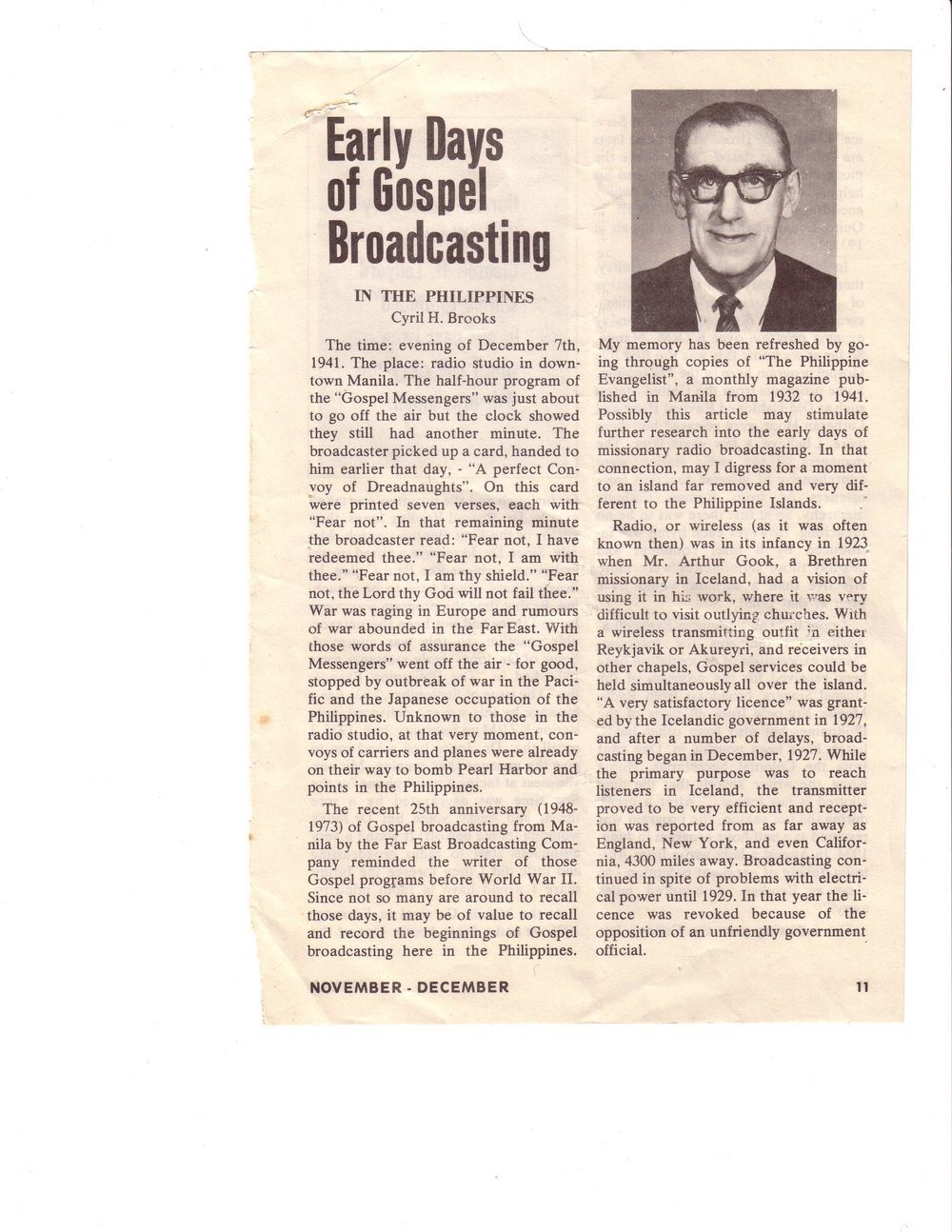
From Signal, November–December 1973, pages 11–14: “Early Days of Gospel Broadcasting in the Philippines.” The original pages: PDF.
The time: evening of December 7th, 1941. The place: radio studio in downtown Manila. The half-hour program of the “Gospel Messengers” was just about to go off the air but the clock showed they still had another minute. The broadcaster picked up a card, handed to him earlier that day, — “A perfect Convoy of Dreadnaughts”. On this card were printed seven verses, each with “Fear not”. In that remaining minute the broadcaster read: “Fear not, I have redeemed thee.” “Fear not, I am with thee.” “Fear not, I am thy shield.” “Fear not, the Lord thy God will not fail thee.” War was raging in Europe and rumours of war abounded in the Far East. With those words of assurance the “Gospel Messengers” went off the air — for good, stopped by outbreak of war in the Pacific and the Japanese occupation of the Philippines. Unknown to those in the radio studio, at that very moment, convoys of carriers and planes were already on their way to bomb Pearl Harbor and points in the Philippines.
The recent 25th anniversary (1948–1973) of Gospel broadcasting from Manila by the Far East Broadcasting Company reminded the writer of those Gospel programs before World War II. Since not so many are around to recall those days, it may be of value to recall and record the beginnings of Gospel broadcasting here in the Philippines.
My memory has been refreshed by going through copies of “The Philippine Evangelist”, a monthly magazine published in Manila from 1932 to 1941. Possibly this article may stimulate further research into the early days of missionary radio broadcasting. In that connection, may I digress for a moment to an island far removed and very different to the Philippine Islands.
Radio, or wireless (as it was often known then) was in its infancy in 1923 when Mr. Arthur Gook, a Brethren missionary in Iceland, had a vision of using it in his work, where it was very difficult to visit outlying churches. With a wireless transmitting outfit in either Reykjavik or Akureyri, and receivers in other chapels, Gospel services could be held simultaneously all over the island. “A very satisfactory licence” was granted by the Icelandic government in 1927, and after a number of delays, broadcasting began in December, 1927. While the primary purpose was to reach listeners in Iceland, the transmitter proved to be very efficient and reception was reported from as far away as England, New York, and even California, 4300 miles away. Broadcasting continued in spite of problems with electrical power until 1929. In that year the licence was revoked because of the opposition of an unfriendly government official.
In an article in “Echoes of Service” March 1959 (from which these facts are culled) it is stated, “We believe the pioneering efforts of Mr. Gook and his helpers were one of the things which encouraged the erection of HCJB in Quito, Ecuador which went on the air in 1935.”
In January 1934, Dr. Paul G. Culley, then a missionary with the Association of Baptists for World Evangelism, commenced a fifteen-minute, Sunday evening program over KZRM, Manila. So far as we know this was the first live Gospel program here in the Philippines. Some programs from the United States, such as Old-fashioned Revival Hour and Lutheran Hour were released but these were, I believe, a few years later. The managers of the radio station were apprehensive of adverse reaction from listeners or from Roman Catholic hierarchy. So at first there was to be no preaching. However each hymn was introduced by a brief comment and possibly those sermonettes were more effective than a sermon would have been at that point.
A note in “The Philippine Evangelist” April, 1934 indicates the response: “Many expressions of appreciation have been received for
the program of the Gospel Singers, broadcast from Radio Manila. Not only from all parts of the Philippines but also from other lands, letters have been pouring in. One card from the Colonial Secretariat, Hong-Kong, the writer ‘regrets that the time allotted is not longer.’” After a break during the hot season, the program was resumed as a half-hour program in June, 1934. In August a lady wrote from Australia, telling of excellent reception — “as clear as Bendigo, a hundred miles away!”
The following year the Culleys left for furlough and the program was taken over by Dr. Russell Bradley Jones, then pastor of the First Baptist Church, Manila. Since Dr. Jones was a gifted speaker but not a singer like Paul Culley, he insisted there would have to be preaching. By that time the program was popular and there had not been the unfavorable reaction, so this was approved. Some of Dr. Jones’ early messages were published in “The Philippine Evangelist.” The issue of September, 1935 has a message by this writer, delivered over station KZRM on February 24th, 1935. I recall that Dr. Jones had asked me to give the message that evening. My nervousness at facing a microphone for the first time was aggravated by a sore throat and husky voice but Dr. Jones wouldn’t let me beg off! It wasn’t a very auspicious start to radio broadcasting and little did I then foresee the future share I would have in radio ministry.
At the Manila Carnival in February 1936 we had a Bible booth. One of the visitors there was an American visiting from Guam. He reported that a large number, about a thousand people, there wait for the Sunday evening broadcast of the Gospel Messengers from Radio Manila. Dr. Jones left for furlough in March, 1936 and turned over the responsibility for the program to me. This was continued until that Sunday in December, 1941, except for a little over a year of furlough, 1937–1938, during which time other friends carried on the program.
Only the Lord knows the real results of these broadcasts in the lives of men and women. The files of correspondence from those
days were lost or destroyed during the war. However two instances of encouragement still linger in the memory. One was a letter from a young wife who had become very despondent because of many problems and was about to take her life. Then she heard the “Gospel Messengers” quartet singing, “All this I have borne for thee, what hast thou borne for Me?” It was the voice of God to her and she found peace and joy trusting in Christ. Shortly before the war, contact was made with another young lady. When we visited her we tried to lead her to Christ as the One who could help her in her problems. It was all too new for her to come to a decision then. After prayer with her, we saw the tears flowing as she exclaimed, “Never in my life have I heard a prayer like that!” I was a bit ashamed that it sounded so ordinary to us but she was accustomed to formal, memorized prayers. Contact was lost because of the war but twenty years later, after a Gospel service a lady approached me. Her face seemed familiar but I could not place her until she told me of that visit and also that now she is a believer in Christ.
A note in “The Philippine Evangelist” in November 1938 shows there had been no charge for radio time until then when the station began charging religious programs. It was a work of faith and the Lord always supplied the needs, whether of finances or personnel. For a time three nationalities were represented in the mixed quartet. That was before the days of tape-recorders so all programs went on the air live. One evening the station advanced our program time by fifteen minutes at short notice. It had not been possible to notify all the participants. As a result the pianist and some of the singers sauntered in quite casually just before we were given the mike. I thought we would have to change the format and start with the message!
One Sunday evening in 1940 an American sailor on a submarine in Manila Bay tuned into the Gospel Messengers. He was a discouraged Christian because he hadn’t found Christian fellowship on shore nor a Gospel program on his radio. The spiritual uplift from our program that evening caused him to write to us. That
contact later led into another area of Christian service for the Brooks family as their home became a servicemen’s home. One who was helped spiritually at that time was a young Air Force man, named Jesse Miller. After World War II, Jesse and his wife were led into work among U.S. servicemen overseas. This developed into the forming of Overseas Christian Servicemen’s Centers Inc., with centers in different countries in Asia and Europe.
During 1941 there was usually a contingent of servicemen in the studio when “Gospel Messengers” went on the air. Their interest, prayers and fellowship were a great encouragement. So that evening of Dec. 7th, 1941 we did not realize how much we were all soon going to need the assurance of those “Fear not” verses. The fellows left the studio to go back to their ships and stations. For some of us, civilians, there was to be Japanese occupation and internment camp. For some of them, the three years of war in the Pacific; for others, the horrors of Bataan, the Death March and Japanese prison camps; and for others, death or missing in action. Whatever happened, the promise was true — “Fear not; I am with thee.”
One closing footnote — the Japanese took control of the radio stations that had been built again under their direction after being silenced before they entered Manila. Some Filipino pastors were invited to preach on Sundays and of course they were expected to conform to the Japanese propaganda. An old friend and a former student in my classes, the late Dr. Santiago Cruspero had taken a most courageous stand for Christ. He was ready to preach the Word but not to give out propaganda. Once he was invited to give a radio message and the first he submitted was disapproved by the Japanese. Unknown to them he then came to me for advice. I thought it rather ironical that I, an “enemy alien”, should help him in that situation. Without compromising the truth of the Word, we succeeded in preparing a message which was approved for broadcast.
Printed beside the article in Signal: “Think It Not Strange,” by J. G. Deck.
Think it not strange then, pilgrim, neither faint,
much less indulge in murmuring and complaint,
if what you meet with in your heavenly road
is hard to bear; since all is planned by God
His child to train in wisdom’s holy ways,
and form a chosen vessel for His praise.
Now we are slow those ways to understand;
but let us bow beneath His mighty Hand,
sure that His wisdom over all presides,
His power controls and love unerring guides.
Ni Cyril H. Brooks · sa Ingles
Progress of Missions in the Philippines
An address by Dad Brooks at a Faith Academy gathering, about 1977, from his typescript in Ken Engle’s file, with his own handwritten corrections.
This evening I have been asked to speak on the topic "Thanks be to God for the achievements of missions here in the Philippines." I thought the best way to do this would be to give a short review of the early history of missions here. There is little need to say much about recent developments since many of you have been involved in those. Since old folks are apt to meander off in the by-paths of anecdotes and reminiscences, I decided I better write down what I wanted to say.
You are all aware that there was no Protestant missionary work here until the end of the last century. Up till 80 years ago people were living under conditions similar to pre-reformation times in Europe. During the 19th century some Spanish Scriptures were imported or smuggled in. In one case, it is said, by disguising them with different bindings.
A Dominican friar in Pangasinan by the name of Lallave obtained one of these Bibles and through reading it was evidently converted. Charged with heresy, he was removed from the priesthood and sent back to Spain. Concerned about his Filipino friends in Pangasinan, he began to translate the New Testament into the language of that area. With the exception of Revelation, this was completed in 1877. This may well have been the first translation of the Scriptures into any of the Philippine languages. However it has often been asserted that in Spanish times the Roman Catholics never translated any part of the Bible into the vernacular. This is not really correct. Certainly they did very little but the Gospels and Acts were published in Tagalog in the 1890's. On two occasions I saw copies of this but was not able to secure one for myself. Reportedly too, some Gospels were translated into other languages.
In Barcelona, Spain, a young man, named Castells, was saved through Dr. Eric Lund, who later came to the Philippines as a missionary. Castells and Lallave came to Manila in 1888 with boxes of Pangasinan New Testaments and Spanish Scriptures. The boxes were held in customs while they went to a hotel in the Walled City. Both of them became very ill and poisoning is suspected. Lallave, who was then an old man, died. Burial was refused until the British Consul intervened so that permission was granted to bury him in the Protestant Cemetery in Makati. Castells recovered, was arrested and deported, along with the boxes of Bibles. For ten years they gathered dust in the British and Foreign Bible Society depot in Singapore.
It was about that same time that some Filipinos were banished to Spain for revolutionary activities. The Bible Society agent there contacted them to begin some translation of the Bible into Tagalog, Ilocano, Bicol and Hiligaynon.
In September, 1898, three weeks after American forces entered Manila, the Singapore agent of the British and Foreign Bible Society arrived here with supplies. For the first time Scriptures were sold openly in this country. When he went north to sell the Pangasinan Testaments, the people were so eager that the agent had to take refuge in a house and sell through the barred windows.
The American Bible Society established an agency here in November 1899, and the two Societies divided the task of translation into the leading languages. This was a tremendous task. They did not have the modern theories about translation and linguistics, so those early versions were often too literal. Yet it was also a dangerous task. A teacher assisting in the Hiligaynon translation was warned to break off relations with this new religion. Because he refused he was one day brutally murdered. In the Visayas two colporteurs started to hike across an island through the mountainous interior. Nothing more was ever heard of them.
In 1919 the British Society transferred their work here to the American Society, while the latter reciprocated in Korea, thus
avoiding overlapping. Up to 1923 most printing of Bibles in Philippine languages was done on a Christian press in Yokohama. In the great earthquake that year, that press and the plates were destroyed. They said there was molten lead six inches thick on the floor of the vault. Though there were some duplicate plates or mats, this was a serious set-back to Bible distribution. A badly-needed revision was immediately begun in most of the languages.
While still on this phase of missions, let me say a little about distribution. Around Lake Lanao there used to be a number of American veterans of the Spanish-American war. Married to Filipinas, they lived on their pensions, most of them dissolute, hard-drinkers. One such was Mr. Ghent. One evening in a drunken stupor, he sent for Mr. Woodward, a Congregational missionary, who had the joy of leading him to Christ. As a result of the wonderful change in his life, Mr. Ghent became one of the most aggressive Bible sellers this country has known. He travelled from town to town with a van. He used his persuasive salesmanship on the parish priest first, for, as he told me once, once the "pare" bought a Bible it was easy to sell to the townspeople.
Another agent, Mr. McLaughlin used a projector with either slides or movies. He would rent a local cine or pitch a tent for his show. The price of admission was a purchase of a portion of Scripture. In our first term, I often spent my mornings going from house to house selling Gospels and Testaments and thus covered most of Manila south of the Pasig. Of course, it wasn't as densely populated then, but still there were 14,000 living in Intramuros alone. Had a basin of water spilled over me from an upper window once, but I think it was an accident. Deliberate or not, it was still wet!
In Bohol, Dr. Graham, a Presbyterian doctor, did an excellent medical and spiritual work. Patients in the hospital received a Testament to take home. A man brought his daughter for treatment from a mountain barrio and returned home with a Testament. Nothing more was heard for six years. Then an agent of the Bible
Society had difficulty selling in a barrio. The people didn't want a book, which they said, makes people do crazy things - like closing the cock-pit, stop drinking "tuba", even going to the poblacion to pay taxes! The agent learned there was such "insanity" in a neighboring barrio and decided to investigate. He found a congregation of 250 people using one very much-worn Testament."
When God opened the door for the preaching of the Gospel there were many Filipinos receptive to this new message, but mostly among the poorer class. Many were opposed to the oppression of the priests and their abusive ways in Spanish times. The writings of Jose Rizal depict the conditions that prevailed. It was not essentially a turning away from the church of Rome. It was not the church that was at fault, they felt, only some who misrepresented it. At that time too came the movement of Gregorio Aglipay, demanding the appointment of Filipinos as bishops. Some of the early missionaries here met with Aglipay but were not able to persuade him to relinquish some of the Roman practices nor the Unitarian tendencies then becoming evident.
In July 1898 some mission boards met in New York to discuss entering this new mission field but no official action was taken. On August 13th, the Sunday after American occupation of Manila, the first Protestant service was conducted by army Y.M.C.A. secretaries. About that time a Methodist lay preacher came here on business. He began services for U.S. servicemen and after a few weeks for Filipinos. Early in 1899, Bishop Thoburn, Methodist Bishop in India, visited here and appointed Mr. Prautch as lay preacher. He was still known as "Deacon Prautch" when I met him some years later.
Dr. James B. Rodgers, a Presbyterian, arrived here in April 1899 as the first resident missionary. He found himself in the midst of a thrilling work before he could get unpacked. Others soon followed and moved out in different parts of the Archipelago. A Ministerial Alliance was formed in 1900 and a year later this developed into the Evangelical Union of the Philippine Islands. Until 1920 this Union
included only American missionaries but that year Filipino pastors and delegates joined. A Sunday School Union was organized in 1911. Several missions established student dormitories in Manila to help young people from provincial churches and to shield them from temptations in the big city.
Medical work and hospitals were also established. I have already referred to Dr. Graham in Bohol, but I also think of Dr. Hall in Tacloban, Dr Thomas and others in Iloilo and Dr. Rebecca Parish at Mary Johnson Hospital. When our children were born there the hospital was right on the waterfront with fishermen drying their nets on the front wall. Reclaimed land now forms the North Harbor and Tondo foreshore between the hospital and the Bay.
Through the Evangelical Union a comity arrangement was worked out: Methodists in Central Luzon; United Brethren and Disciples in Northern Luzon; Presbyterians in southern Luzon and eastern Visayas; Baptists in western Visayas; Congregationals and Christian and Missionary Alliance in Mindanao. It was only natural that in those early years much of the missionary work was carried on in the more accessible areas. There were so many open doors and so much need that remote places and tribal areas were left for later on.
Another feature of the progress of the Gospel in the Philippines has been the formation and spread of many independent Filipino churches. One of the first was started by Nicolas Zamora in 1909, the "Iglesia Evangelica Metodista en las Islas Filipinas", generally known as IEMELIF. This has been followed by a great many more. Most denominations have experienced such break-aways or hive-offs. In some cases there was a factor of nationalism and that is not necessarily bad. In others a forceful leader attracted a group of followers to himself. Others arose because of some doctrinal difference.
According to the 1918 census there were 7¾ [?] million Roman Catholics, 1½ million Aglipayans, 1 million Moslems and pagans, and 124,575 Protestants. The progress in 20 years seems to have
been slow. Then there was more opposition from the dominant religion. A Filipino pastor in Samar was brutally beaten and almost died. In the 20's we lived in Indan (now Vinzons), Camarines Norte for a time. There were no believers there and we were told we would have been run out of town if we had not been Americanos. There were cases where local priests refused burial to Protestants in some towns where there were no municipal cemeteries. Often the believers lacked social prestige and their churches were unimpressive. Many of them from the poorer class and also first-generation Christians.
As the influence of liberal theology was being felt, some missionaries were unwilling to follow the comity plan of the Evangelical Union, specially in the decade prior to World War II. A growing work among the Chinese community was largely indigenous and foreign missionaries had only a minimal part. Filipinos, Chinese and American worked together in a camp for young people, known then as Philippine Keswick Camp. For some years it was held between Christmas and New Year in the Montalban Gorge and for two or three years on a ranch, where the Valley Golf Club is now. In 1932 a monthly magazine, The Philippine Evangelist, was published as a joint effort until the outbreak of war. For seven years it was my privilege to write the S.S. lesson notes for that publication.
In 1934 Dr. Paul G. Culley of ABWE commenced a radio program. The program manager was at first fearful of adverse reaction by the hierarchy to any preaching. Dr. Culley got around that by brief introductions of each Gospel hymn. This changed when Dr. Russell Bradley Jones took over the program. He was an excellent preacher but not a singer like Dr. Culley. When he went on furlough in 1936 I was asked to take over. This program "The Gospel Messengers" continued until Sunday, December 7th when the Japanese were already on their way to Pearl Harbor. At least two well-known U.S. programs, the Old-fashioned Revival Hour and the Lutheran hour were also being released over Manila stations. In the
late 1930's ABWE had a Gospel ship operating in waters around Palawan and Sulu. It also made one or two voyages to New Guinea which was largely unevangelized then.
With the outbreak of war in the Pacific some missionaries evacuated to Baguio. Others were directed to go to Pagsanjan as an evacuation point. However the Japanese invasion was so rapid that it proved just as safe to stay in Manila which was entered by the Japanese on Jan. 2, 1942. A few missionaries, mostly transients caught in Manila by the war, were repatriated in 1943. For most there was no opportunity to leave after war broke out.
All civilian aliens were ordered to report to internment camps. In Manila this was at Sto Tomas University. On January 15th, 1942, religious workers in Manila area were released to live in their homes under surveillance. This permitted some of us to continue our work in the churches in a limited way. Great discretion was needed as weekly reports of activities had to be submitted, and we never knew who might be spies. Most Filipinos were very friendly but they also had to be careful. Some missionaries were confined to Fort Santiago for not cooperating in the propaganda drive of the Japanese. Others escaped this because they were not so closely supervised. In 1944 three lady missionaries, Mrs Stagg, Dr. Darby and Miss Wilks were executed, along with two nuns, because of contacts with the guerillas. A group of Baptist missionaries hid out in the hills of Panay but in 1943 were betrayed by collaborators and killed by the Japanese. Others hid out in Mindanao and Palawan and some were evacuated to Australia by submarine in 1944. Others died from sickness and malnutrition in the internment camps.
The Japanese tried to gain control of the churches for propaganda purposes by forcing all denominations into a church union. Some resisted this pressure but other national church leaders collaborated. Possibly they saw an opportunity to get high positions in their organizations. Services were permitted in the churches but outside activities were banned. Of course, one advantage was that nationals were assuming more responsibility in their churches.
During the fighting attendant upon liberation, many church buildings were destroyed or damaged and many of the members scattered. In many cases they lost their homes and possessions and sometimes their lives. There were a number of Christians among the U.S. Armed Forces pouring into the Islands. In many places they found fellowship with Filipino Christians and helped them in rebuilding their churches and homes.
As we thank God for the achievements of missions here we recognize that the greatest advance has been made since World War II. I will not burden you with particulars about this growth in the past 30 years for many of you have had a part in it. Instead let me point out some factors which have contributed to this growth.
First, let's not overlook the factor of population growth. Do you realize that there are now five times as many people here as when Protestant missionary work began? That the population has more than doubled since World War II? Growth in population ought to be accompanied by growth in missionary effort but often the latter lags behind. This challenge is constantly before us. Let us be thankful for the new outreach into tribal areas by such groups as Summer Institute of Linguistics, New Tribes Mission, Overseas Missionary Fellowship and others.
Second, the expansion of missions is related to what I mentioned a few moments ago - the influence of Christian G.I.s. It worked in two ways. An impression was made on many Filipinos who were not Protestants. Americans who were not ashamed to fellowship with Filipinos in a little bamboo chapel, in spite of language barriers. As they worked and helped in a practical demonstration of Christian faith, a little more prestige was gained by small evangelical congregations. Then too there was the effect upon the G.I.s. They found they could communicate more than was possible in the south Pacific and were received with traditional Filipino hospitality. They saw more of the results of missionary work and also had a vision, a challenge as to future possibilities. God was working in many lives. The most marked example of this is Far Eastern Gospel Crusade,
born in a servicemen's center in Manila in September 1945. About the time that Faith Academy came into existence, I would guess that at least half of the male missionaries here then had previously been here as chaplains or G.I.s.
A third factor has been the modern methods of evangelism developed in recent years. Radio came into a much wider use as the impact of Far East Broadcasting Company was increasingly felt throughout the Islands. The seed was being sown and others were reaping a harvest. Back to The Bible Broadcast and others were using commercial stations and later television has been used. There has also been an increased use of various forms of literature, Gospel recordings and correspondence courses. Since 1950 the Bible School of the Air has had over 1½ million requests for courses through the country.
A fourth factor has been the large increase in number of missions working here since 1945. This has been partly due to the closing of doors to missionaries in China and South-east Asia. Forced out of those fields by the advance of Communism, they looked for adjacent fields of service. Here in the Philippines they found freedom of religion, a measure of political stability and an open door. Along with this, mention should also be made of another cause for thanksgiving - that is, that increasingly Filipinos are going as missionaries to other countries.
A fifth factor contributing to the progress of missions in this country has been the change within the Roman Catholic Church. In March 1937 Testaments and Gospel literature were publicly burned in Zamboanga. On Billy Graham's first visit here 20 years ago, for one public service, the Archbishop forbad Roman Catholics to attend. In this recent Crusade, I am told that 60% of the inquirers were from that church. Since Vatican Council II Protestants have been elevated from heretics to separated brethren. Conflicts have arisen within what was supposedly a monolithic church. Questions arose as to papal authority. Roman Catholics participated in ecumenical movements and in Bible translation. The Bible became
available to the laity. All of these things had made for an openness to the Gospel that was unthought of a few years ago.
Thank God for the progress in Missions, a progress that is going on. "The Lord has done great things for us; we are glad." (Psalm 126:3). But past progress presents a challenge! The fields are ripe for harvest! The time is short! So our gratitude to God is no occasion for self-congratulation.
May I just add that I think Faith Academy has also made its contribution even though the primary aim is not evangelizing nationals. It has brought together many workers of different missions so that we have a greater appreciation of one another. We do have our doctrinal differences. We don't all agree on methods and church practices. We are, I suppose, not prepared to sacrifice or compromise truths that we value just for the sake of organizational union. But we have learned to recognize one another as brothers and sisters in Christ in spite of our differences. On occasions like this we can fellowship together. We have united together so we can provide a better education for our children (and may I say, grandchildren). This too is something for which to praise the Lord in the achievements of missions.
Ni Cyril H. Brooks · sa Ingles
Call to Missions
A Bible study on Acts 13 by Cyril H. Brooks. Where it was first printed is not recorded in the family file.
The book of Acts has rightly been called the “Missionary Manual of the Church.” There are two things to remember in studying this fifth book in the New Testament. First, here are Scriptural and spiritual principles for us to follow in our missionary work. Second, while these principles will not change, yet the strategic methods of carrying out these principles will vary. Before studying Missions in the book of Acts, there are a few characteristics of this book that deserve our attention. (a) There was complete dependence upon God the Holy Spirit, so that this book is often called “The Acts of the Holy Spirit.” (b) There was a simple and natural development of the work, for God’s work is frequently depicted as a growth. (c) Following evangelism, there was an emphasis upon establishing local churches so that believers could meet together for worship, fellowship and instruction. (d) There was an absence of organization, board, or councils exercising authority over local churches. (e) Three is little mention about financial support of workers and no record of the number of converts (except in round figures in two cases –2:41, 4:4).
In this study we will consider the Call to Missions. We are all familiar with the Great Commission given by Christ to His disciples. Its importance may be gauged by the fact that it is found in different words in each of the four Gospels and in the first chapter of Acts. His final words, His parting blessing before He ascended contained this: “But ye shall receive power, after that the Holy Spirit is come upon you: and ye shall be witnesses unto Me both in Jerusalem, and in all Judea, and in Samaria, and unto the uttermost part of the earth.” At that time, as indeed through all the history of the Church, there seems to have been hesitancy in fulfilling that last phrase. It was not until there was persecution in Jerusalem that they went further afield (8:1, 11:19). Then some “traveled as far as . . . Antioch” and this led to the establishing of a
church in Antioch which became the base for missionary expansion. No doubt God had a purpose in using Antioch as such a base rather than Jerusalem. This church was composed very largely of Gentile believers and the choice of Antioch would dispel any idea that Jerusalem was the “parent” or head church with authority over others.
Let us study this call from three aspects: (a) The Call of the Holy Spirit; (b) The Consent of the Local Church; (c) The Consecration of the Missionaries.
In connection with the Call of the Spirit we note that it was His prerogative to call and it was by His power the workers were sent forth. While there are many different gifts or abilities given to the members of the body of Christ, yet in apportioning these gifts, the Holy Spirit is sovereign. He divides to every man “as He will” (I Cor. 12:11). Believers should earnestly desire the best gifts but the designation of these rests with the Holy Spirit. It was the Spirit who said: “Separate Me Barnabas and Saul.” There were not simply following their own inclinations, nor were they stirred by the emotional appeal of some other worker. It was not the church, nor the elders and teachers in that church who called them, but the Holy Spirit. We are not told just how the Spirit spoke to them. Did they hear a voice? Or see a vision? Or was it simply an inward conviction in their hearts concerning the will of the Spirit? The details are not revealed lest we should think it would have to be that particular way. The Spirit of God has different ways of making His will known. It is also important to note the words of verse 4: “So they, being sent forth by the Holy Spirit, departed . . .” As the Spirit of God had called them, so also He sent them forth on their mission. They were not sent by any organization; not even by the church in Antioch. A different word is used at the end of verse three to indicate the action of the church in letting them go. In the case the Tagalog Bible has a better translation than the English King James version.
The church at Antioch which thus gave its consent was in many
ways rather a model church. They had been taught well by Barnabas and Saul (11:26) and had a variety of teachers (13:1). It was an active church as they ministered or served the Lord. Their fasting indicated their concern and exercise of heart so that they readily recognized the call for the Spirit. We wonder if they were fasting because they were burdened about the needs of those who had not hear the gospel! When they heard the call of the Spirit, they fasted and prayed, for it was not easy to give up their best men. For some time they had been edified by the teaching ministry of Barnabas and Saul. Their leaving would mean added responsibility for those left in Antioch. Yet even as they prayed, they could hardly have realized how important a move this was in the history of the Church, nor how far-reaching its outcome would be. When they laid hands on Barnabas and Saul, this was not in the sense of conferring on them any ability or authority. These two had already displayed their ability and authority as teachers in Antioch. The laying on of hands was an act of identification. Just as the Israelite of old identified himself with the animal sacrifice, sot he church in Antioch through their leaders indicated that the missionaries were going forth on their behalf to carry out a task which was common to all. So they commended them to the grace of God for the work of the Lord (14:26). It is worth noticing that this was done altogether apart from the apostles and church in Jerusalem.
Now let us briefly notice the consecration of the missionaries. This was not something official on the part of the church but rather the personal dedication of these workers. These men were promptly obedient to the Spirit’s call and devoted themselves completely to the work to which they had been called. They were men who had already proved their ability and thus were shown to be fit and ready for the call to a wider sphere of service for the Lord. No doubt it was not easy for them to give up the work they had been doing in Antioch nor to leave the happy fellowship with the brethren. However, the authority of the Holy Spirit was supreme, the call of God was unmistakably clear, so they set forth. Like Abraham of old—“By faith Abraham, when he was called . . . obeyed: and he went
out, not knowing whither he went.”
How important to be sure of God’s call when setting for the in missionary work. Barnabas and Saul took a companion with them, the young man John Mark. It was not long before this young man returned home. Various reasons for this have been advanced. Was it because he was not fortified by the conviction that he had been called of God? A brother from the Southern states encountered a worker of whose call he had some doubts. Finally one day, in exasperation he said: “Brudder, was you sent or did you just went?” Barnabas and Saul were called by the Spirit but it looks as if Mark “just went.”
Ni Cyril H. Brooks · sa Ingles
Daily Church Growth
A Bible study on Acts 16:5 by Cyril H. Brooks, probably the Missions article on church growth that Ken praised in his letter of 4 January 1983.
Considerable attention has been given in recent years to Church Growth and Church Planting. This is most commendable because it is also scriptural. However, sometimes the proponents of Church Growth sound as if they had just discovered some new approach and some new objective in missionary work. It is not new to those who have studied missions in the light of the New Testament.
On their first missionary journey, Paul and Barnabas evidently encouraged the new believers to gather together in local church fellowships. This must have been new truth to those believers, yet we find that on the return part of their journey, Paul and Barnabas appointed elders in each church (Acts 14:23).
Later on, Paul, along with Silas, started on a second journey and one of their objectives was to visit many of those young churches. At Lystra there was a young man, Timothy, who had probably been saved on their first visit there. With the commendation of the brethren at Lystra and Iconium, Paul took Timothy as his companion and fellow worker. Then we read, “So the churches were strengthened in the faith and grew daily in numbers” (Acts 16:5 NIV).
Many of the commentaries seem to pass over this verse as self-explanatory but it does merit some consideration. In fact it is quite a remarkable statement! We have no idea what period of time is covered here, whether days, weeks or months. We can only surmise what a great amount of missionary energy and effort was expended. No doubt there were many hours of faithful teaching of the Word of God. On another occasion Paul wrote, “You know that I have not hesitated to preach anything that would be helpful to you but have taught you publicly and from house to house” (Acts 20:20 NIV). Paul and Silas had been obedient to the Great Commission – “teaching
them to obey everything I have commanded you” (Matt.26:20 NIV).
What is impressive in Acts 16:5 is the word “daily.” As in the first days of the church souls were being saved regularly and daily, “The Lord added to their number daily those who were being saved” (Acts 2:47). What a challenge this presents! Is this happening anywhere today? Here was church growth on a daily basis. No doubt, as the churches grew in numbers, there would be hive-offs with new churches established. Yet church growth is not simply a matter of statistics. Reports of churches with thousands of members may be largely meaningless in terms o spiritual growth. Possibly man in such churches are merely church joiners or pew warmers – people lost in the crowd without any active participation in the work of the Lord.
There can be no real church growth without spiritual growth in the lives of individual believers. Driving past a church building I saw this on the bulletin board -- “What does C-H-R-C-H spell without U?” Are you involved in the growth of your local church? Is there even weekly or monthly growth in your assembly? Sad to say, some seem to have no growth at al. An elder from an assembly in the Philippines recently visited the United States. On his return he wondered, whimsically, if we shouldn’t be sending missionaries there! The key to church growth is the personal, spiritual growth of each member, growth that will result in serving the Lord in witnessing and winning souls for Christ.
Such spiritual growth is suggested in the first part of this verse, “So the churches were strengthened in the faith.” A strong church will be a growing church. There can be little growth where there is weakness. This is often seen in the physical realm. Children who are weak through malnutrition do not grow and develop as they should. Spiritual malnutrition is far too common among God’s children. They are not being strengthened in the faith and so the church is not strong and is not growing. Systematic Bible teaching is needed, along with application of the truth to the daily life.
Sometimes spiritual malnutrition is due to lack of appetite for
the Word. An interesting illustration of this is found in 2 Samuel 13. Amnon, one of David’s sons, was asked by his friend Jonadab, “why do you, the king’s son, look so haggard morning after morning?” It was evident that Amnon was not eating much, even though, as the king’s son, ample food was available. The effect of this was obvious in his appearance! Then the truth came out! He was in love with his half-sister, a forbidden relationship. So some Christians, the King’s sons, are weak and haggard spiritually. Is it not because of lack of appetite for the bountiful provision for them in the Word of God? That lack of appetite is often due to an illicit love, a desire for something which is not according to God’s will.
Cause and effect! When believers are feeding on God’s Word they will be “strengthened” or “made firm” in the faith. “Like newborn babies, crave pure spiritual milk, so that by it you may grow up in your salvation” (1 Peter 2:2 NIV). Thus the churches will be strengthened in the faith and the effect of this will be church growth. Is there any reason why there should not be daily growth, as in Paul’s day, if each one does his part?
Ni Cyril H. Brooks · sa Ingles
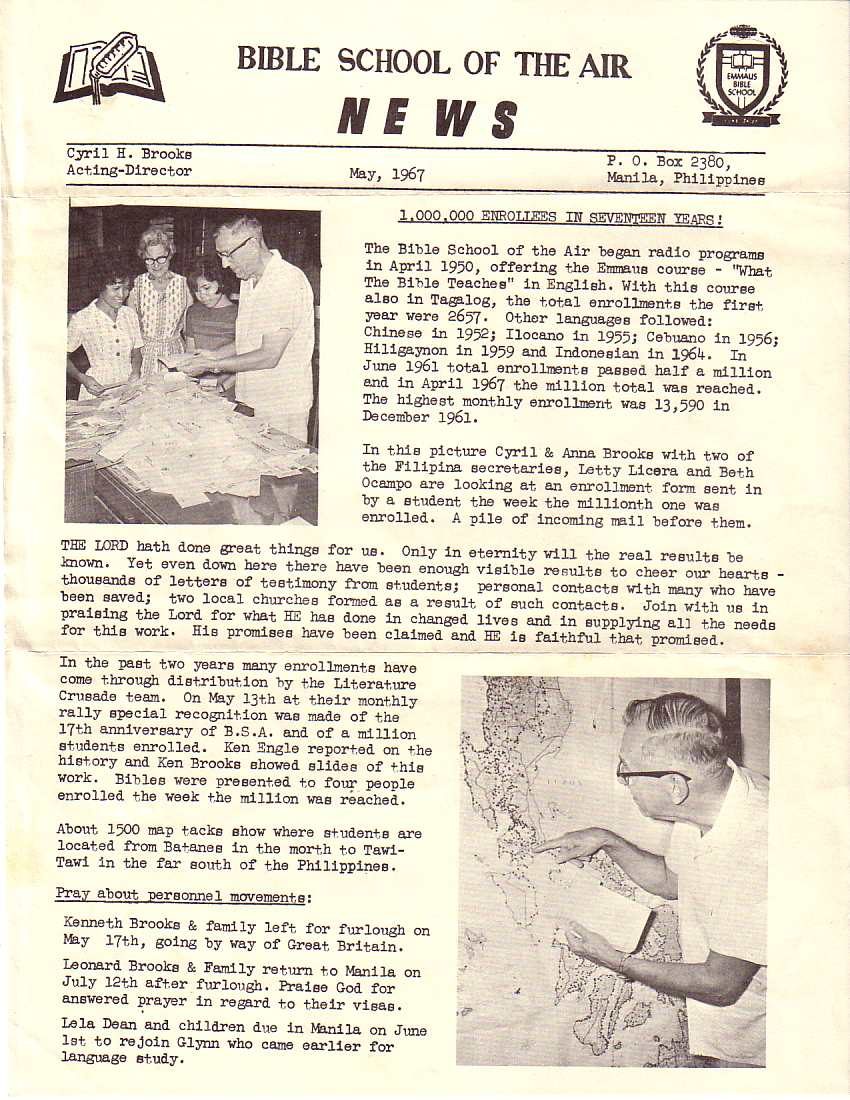
Bible School of the Air News, May 1967
The newsletter Cyril H. Brooks sent out as Acting-Director, P.O. Box 2380, Manila, in May 1967, the month the millionth student enrolled. It is one page; the original is shown in Part Four, “One Million Students.”
1,000,000 Enrollees in Seventeen Years!
The Bible School of the Air began radio programs in April 1950, offering the Emmaus course - "What The Bible Teaches" in English. With this course also in Tagalog, the total enrollments the first year were 2657. Other languages followed: Chinese in 1952; Ilocano in 1955; Cebuano in 1956; Hiligaynon in 1959 and Indonesian in 1964. In June 1961 total enrollments passed half a million and in April 1967 the million total was reached. The highest monthly enrollment was 13,590 in December 1961.
In this picture Cyril & Anna Brooks with two of the Filipina secretaries, Letty Licera and Beth Ocampo are looking at an enrollment form sent in by a student the week the millionth one was enrolled. A pile of incoming mail before them.
THE LORD hath done great things for us. Only in eternity will the real results be known. Yet even down here there have been enough visible results to cheer our hearts - thousands of letters of testimony from students; personal contacts with many who have been saved; two local churches formed as a result of such contacts. Join with us in praising the Lord for what HE has done in changed lives and in supplying all the needs for this work. His promises have been claimed and HE is faithful that promised.
In the past two years many enrollments have come through distribution by the Literature Crusade team. On May 13th at their monthly rally special recognition was made of the 17th anniversary of B.S.A. and of a million students enrolled. Ken Engle reported on the history and Ken Brooks showed slides of this work. Bibles were presented to four people enrolled the week the million was reached.
About 1500 map tacks show where students are located from Batanes in the north to Tawi-Tawi in the far south of the Philippines.
Pray about personnel movements:
Kenneth Brooks & family left for furlough on May 17th, going by way of Great Britain.
Leonard Brooks & Family return to Manila on July 12th after furlough. Praise God for answered prayer in regard to their visas.
Lela Dean and children due in Manila on June 1st to rejoin Glynn who came earlier for language study.
Mga Larawan at Papeles
Mula sa talaksan nina Ken at Mary Lou Engle tungkol kina Dad at Mom Brooks
Idinagdag noong Oktubre 13, 2026
Mga Larawan at Papeles
Ipanalangin Kami
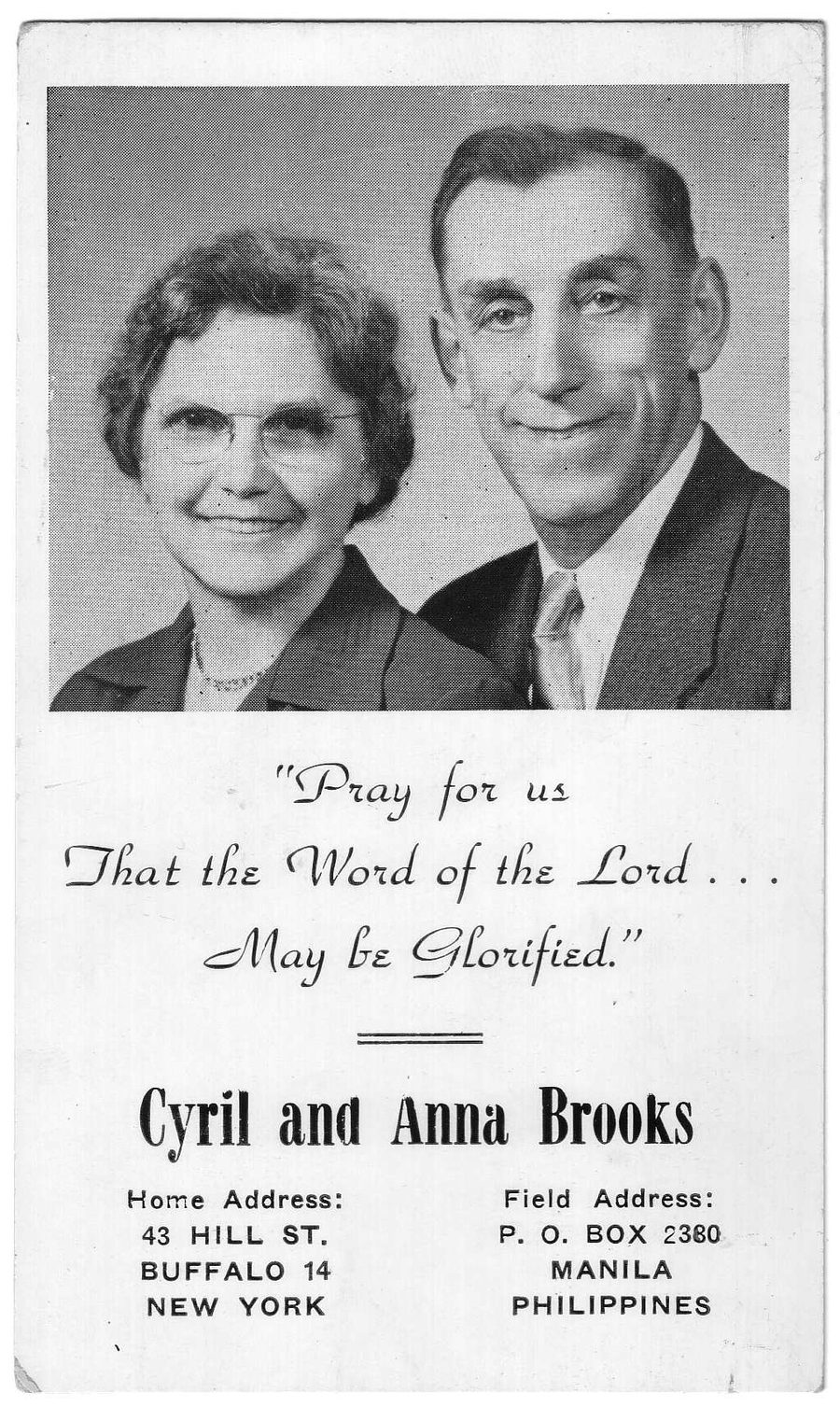
Mga Larawan at Papeles
Mula kay Cyril Brooks
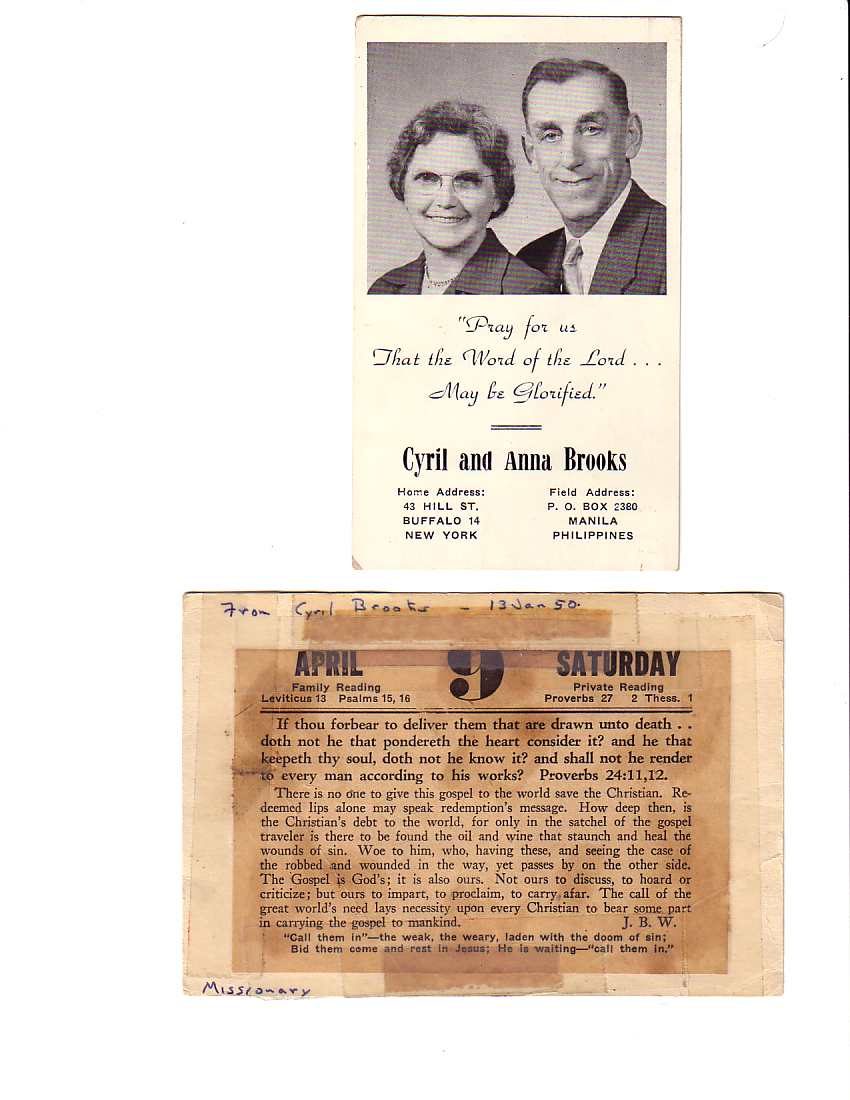
Mga Larawan at Papeles
Isang Milyong Mag-aaral
Mga Larawan at Papeles
Apatnapung Taon
Mga Larawan at Papeles
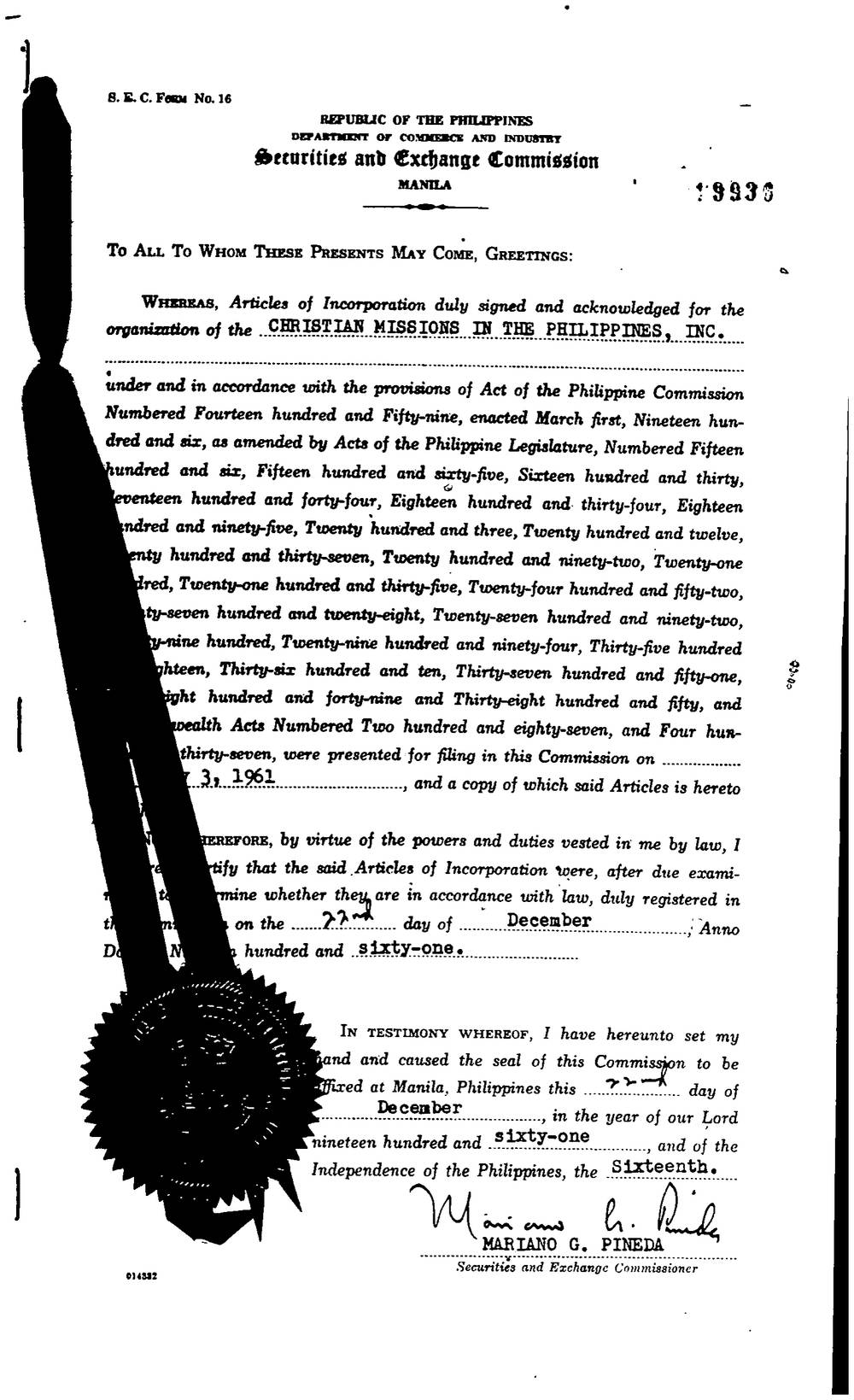
Christian Missions in the Philippines, Inc.
Mga Larawan at Papeles
Animnapung Taon
Mga Larawan at Papeles
Ang mga Larawang Pinili ni Ken
Mga Larawan at Papeles
Ang mga Larawan, karugtong
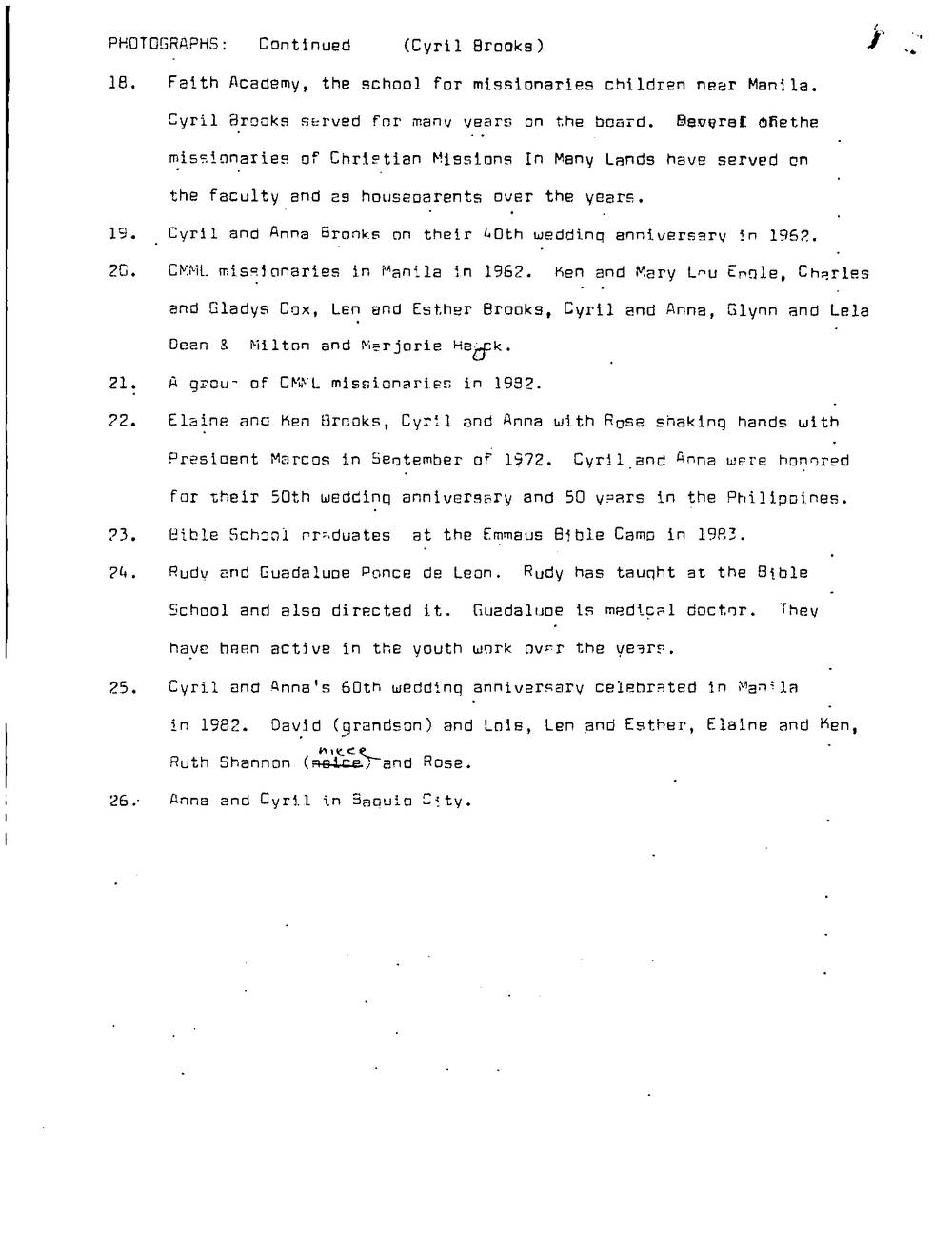
Mga Larawan at Papeles
Ang Orihinal na mga Pahina, 1981
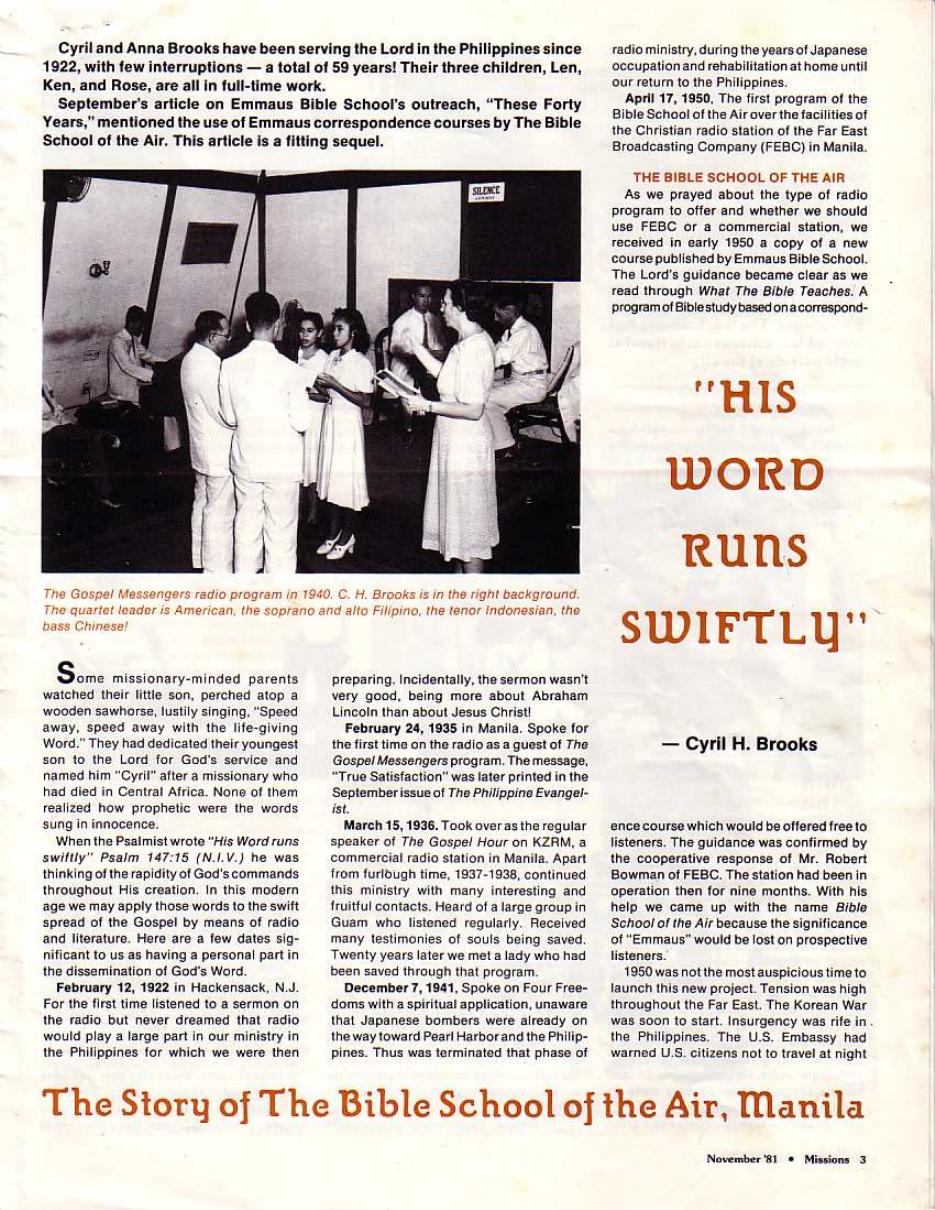
Mga Larawan at Papeles
Ang Orihinal na mga Pahina, 1973
Basahin Pa
Bawat link ay bubukas sa bagong window, kaya makababalik ka agad sa pahinang ito.
- Cyril H. Brooks on PlymouthBrethren.org ↗His author page, with his writings.
- Grace Triumphant on PlymouthBrethren.org ↗The whole book, chapter by chapter.
Mga Pinagkunan
Batay ang tomong ito sa Grace Triumphant, ang sariling talambuhay ni Cyril H. Brooks (Walterick Publishers, Kansas City, © 1985); sa kaniyang mga artikulo sa Missions (1981) at Signal (1973) at iba pa; sa Bible School of the Air News ng Mayo 1967; at sa talaksan nina Ken at Mary Lou Engle tungkol sa mga Brooks: mga liham mula 1959 hanggang 1986, ang tala ni Ken, ang listahan niya ng mga larawan para sa aklat, at ang liham ni Rose Brooks noong Marso 12, 1986. Ang mga sipi mula sa aklat ay isinalin sa Tagalog para sa seryeng ito.
Lahat ng link sa tomong ito ay nakalista rin sa pahina ng mga Link.
Mga Kasamang Aklat
Katabi ng limang tomo ng kuwento ang pitong kasamang aklat.
- Sa Kaniyang Kagalakan: Ang Buhay at Ministeryo ni Ken EngleMga liham mismo ni Ken · 1951–1987 · ang kaniyang buhay at ministeryo
- "Mary Lou, Mary Lou": Ang Kuwento nina Evelyn at Fred BalanagLungsod ng Baguio · 1968–2010
- CherylCheryl Lyn Engle · ang kaniyang buhay, musika at sariling mga salita
- Karen, Patrick, at Romblon: “Dinadala ang Pangitain”keepm.org · ang Emmaus app · Moments to Remember · sina Karen at Patrick
- Mga Kuwento ng Pamilya at mga KaibiganMga kaibigan ng gawain · mga kuwento ng pamilya · sanggunian ng pamilya
- Mga Alaala ni KevinKevin Engle · sa sarili niyang mga salita · Stewards Foundation · Sa Sariling mga Salita ni Itay
- Herald of Christ: Ang Kuwento ni Rudy Ponce de LeonSan Juan, Rizal · 1951–1996
Faithful Men: Isang Aklatan ng mga Klasikong Kristiyano, mula sa PlymouthBrethren.org: mga manunulat na Brethren at mga buhay ng misyonero, mahahanap ayon sa may-akda, Kasulatan at paksa. Buksan ang library ↗
Ang Susunod
Ito ang Ikawalong Tomo ng Panginoon, Ibigay Mo sa Amin ang Bundok na Ito. Nasa Talaan ng Nilalaman ang lahat ng aklat ng serye.
Ingatan sila para kay Jesus hanggang sa walang hanggan.
ang panalangin sa likod ng KEE Philippine Missions
I-drag ang sulok ng pahina, i-click ang gilid ng pahina, o gamitin ang mga arrow key upang maglipat ng pahina. Lahat ng tomo · Read in English